Now WASH your hands
At the beginning of the year I received an e-mail from my friend and Health Images colleague Petra Rohr-Rouendaal. Petra had been asked by Oxfam to do two hundred and twenty five black and white line drawings about water, sanitation and hygiene issues, for use in emergency situations around the world. She’d been working on this for a while, when it was decided that the drawings would be good in colour. In her e-mail, Petra, whose work is always in great demand, intimated that she could do without colouring all these images as well as drawing them in black and white. I replied, rather flippantly, that I would be happy to colour them if she didn’t want to, as I didn’t have much work on at the time.
So, between February and the end of June, that’s what I found myself doing. Seventy five images for Sub-Saharan Africa, the same number for Latin America and a similar set for Afghanistan and Pakistan. People shitting behind bushes, latrines, people washing their hands, preparing food, going to church, mosque or hospital, watching a puppet show, groups talking with each other, women collecting water from pumps and rivers, chains of contamination and so on... More or less every day for four months several hours on Photoshop for me, no exercise, a pain in the neck, an overworked mouse, but feeling that I was doing a worthwhile project, saving the world rather than designing leaflets for music festivals and drama productions. Stamina and deadlines and pleasure from working on Petra’s great drawings.
So, when I got an e-mail from a young Oxford graduate called Sarah-Jane Knock, asking if I would display some Health Images pictures at a conference entitled “Students and Development” at St. Anthony’s College, I gladly accepted the offer of a brief change of scenery. (The other changes of scenery I had had during this period were a short trip to Amsterdam and a couple of visits to the James Paget hospital in Gorleston for uncomfortable tests to see if I had bowel cancer).
In the Rose Garden
A couple of days before driving down to Oxford, Jacky and I attended a reception put on by our local environmental conservation charity The World Land Trust, for whom I’ve done graphics over the past twenty years or so. It was held at the home of Andrew and Alexandra van Preussen in Horham, near Eye in Suffolk. David Attenborough was there and it was nice to see him in the flesh, in his crumpled linen jacket. One of the van Preussen’s pride and joys, of which they seem to have several, is their rose garden. Since one of the WLT’s latest projects is in Paraguay, they had invited two musicians, Alberto Pino and Christoval Pederson, formerly members of Los Paraguayos, to play their instruments, a guitar and a harp, in the rose garden. Terribly civilised on a June evening in rural England, pink champagne and canapes.
Presentations were made in the Great Barn and included a film of David Attenborough in his twenties, on a politically incorrect ‘Zoo Quest’, wearing a dark suit and tie in the rainforest. After the film, Sir David said that he had done everything he could to stop it being shown, even offerring to bribe the WLT. He explained ruefully that even this had failed and commented that this had probably been the first time that the WLT had refused to accept money. Referring to his younger self, he asked, quizically, “Who was he?”.
And so to Oxford...
The drive across to Oxford was uneventful until I lost my way on the outskirts. I passed the huge Cowley car plant where they make some of the smallest cars in the world - Minis. Taking a wrong turn, I entered the village of Sandford upon Thames. I saw two people sitting at a bench outside the village pub, so pulled up to ask if they could direct me to Freelands Road in Oxford.
They turned out to be a friendly couple who were, in fact the pub’s landlord and landlady, relaxing as they had no customers. The man went into one of the neighbours’ houses to ask if they could help. The landlady shouted out to her daughter to come outside. An extremely fat thirteen year old girl came to the pub doorway.
“When you go on the school bus, is there a stop at Freelands Road?” “yes”, the girl replied glumly, “It’s just past the garage that’s closed down”. The mum was then convinced that she knew the place and gave me accurate directions. Then the landlord returned from the next door cottage with completely different directions.
Just recently I’ve been reading ‘Waterlog’ by Roger Deakin, in which he mentions the village of Sandford on Thames, in which I had mistakenly arrived. He talks about Jerome K. Jerome’s ‘Three Men in a Boat’ in connection with Sandford and quotes the author’s description of the Sandford lasher, whatever that is. “The pool under Sandford lasher is a very good place to drown yourself in”.
I met Sarah-Jane Knock at her house and was introducede to her house-mate Jo, a rather serious girl who had just finished her finals in Pure Maths and Logic. I was well impressed and thought how wonderful it must be to study pure mathematics for three years in Oxford when you were young.
A pair of crossed oars were displayed on the kitchen wall. These had been gained by Sarah-Jane’s fiancee, John. “I haven’t got my blades yet”, she explained. They were also into rock climbing and bouldering. I said I used to go out with a girl from Chesterfield and not far from where she lived we used to watch rock climbers. It was out beyond Chatswirth Road, the road in which my former friend lived. “Wow”, expostulated Sarah-Jane, “ I used to live just off Chatsworth Road, in Holymoorside”.
Another small and insignificant coincidence. She then told me that her non-identical twin sister was now working for the government’s Child Poverty Unit, having also done a degree at Oxford, a city partly populated by boys and girls who had done well at school, many having been head-boys and head-girls.
We drove to St. Anthony’s college with the stuff for the exhibition. With the help of her friend Emmanuel, an interesting French boy with a long face who was also studying International Development, we put up the Health Images display.
Another coincidence
In the evening I was on my own, as Sarah-Jane was going off to a ball at Balliol. Before leaving, she gave me directions to a couple of recommended pubs. I walked into town alongside the Thames which is, I think, called the Isis in Oxford. I made my way on the towpath past the boathouses of various colleges and saw the narrowest narrow boats I’d ever seen. Meeting the road by the ‘Head of the River’ pub, I crossed over the bridge and made my way into town, passing several American tourists en route.
When I reached Cornmarket, I was surprised to see, in the distance, a busker playing a harp. I walked slowly past, enjoying the sound, and bent down to put some coins into the busker’s hat. Straightening up, I looked briefly at the harpist and was astonished to find that I recognised him. Yes, it was Cristoval Pederson, the Paraguayan harpist I’d met two nights previously in the rose garden in Suffolk. We laughed and greeted each other. “What are you doing here?”, I asked. “I’m busking”, replied Cristoval. He was staying with a friend in Oxford and would be doing a gig the following night at the Holywell Music Room with a singer called Miriam Scruby.
I wandered past a long queue of students in dinner suits or shiny dresses, waiting to get into the ball at Balliol. Then, down an alleyway, I found ‘The Turf’, an ancient higgledy-piggledy tavern which sells moderately good ale. Next, I partook of another solitary pint of beer in ‘The Eagle and Child’. This was the pub where a literary group, who called themselves ‘The Inklings’ met to discuss literature and have a drink. C.S. Lewis and J.R.R. Tolkein were leading members with a religious bent.
Continuing my modest pub-crawl, I called into ‘The Head of the River’ pub, where the TV was showing a European Championship football match between Turkey and Croatia, historical adversaries. At the final whistle, I made my way back along the towpath, finally arrivig at Freelands Road where I read a few pages of Louis de Berniere’s brutal ‘War of Don Emmanuel’s Nether Parts’ before nodding off.
In the morning, I decided to go back into town, so was soon plodding again along the towpath. The drizzle was moderate to heavy and there was plenty of Saturday morning activity in and around the boatsheds. I saw thirty dicks and ducklings all in a line, proceeding in an easterly direction on the river. Several coaches cycled along the towpath shouting at young rowers. “Bury that blade!”, “Wrist flat, arms straight”, “Charlotte, sit up, don’t hunch”, “Not like that”, “That’s better”, “Keep going”,
Up in town, a young man handed me a leaflet I hadn’t asked for. He had a placard that read “Have you met your father yet?”. The leaflet was quite a dark red with black type, like letterpress. On the back it said “A child needs its parent, human beings need the Creator”. I went into the HMV store.
Browsing through the CDs I noticed “Inna Gadda da Vida” by Iron Butterfly and UB40s “Rat in the Kitchen”, the cover of which I designed twenty years ago. It looked like our kitchen at Holly Tree Farm, which hasn’t changed much except that there are now no American jets in the windowframes. The peace dividend that never happened much. I weanted a new CD to play on the journey home but couldn’t find anything among the millions of albums. Funny, but it happens that way sometimes.
Natural History in Cabinet
Heading towards the university’s Natural History Museum, I spotted several empty Veuve Cliquot bottle, presumably discarde after the ball. Headaches this morning, strangers in strange beds. Inside the museum I first noticed a flock of busy bird enthusiasts from the Oxfordshire Ornithological Society. They were nerdlike and may have lived with their mothers.
Just along from the OOS display was a chest of museum drawers with six rows and four columns. On top was a sign that said ‘Natural Histort A-Z’. It was a game for children. On the front of each of the drawers was a letter of the alphabet. U and V shared a drawer, as did X, Y and Z. The bottom drawer contained the answers. Work it out for yourself. In each drawer were specimens from the collection whose names started with the letter on the front of the drawer. I opened a few. In M were shells, for Molluscs. In R was a rabbit, sectioned vertically to exhibit its internal structure. In D resided some very large and shiny Dung Beetles.
The roof of the museum was made of ironwork, rather like a Victorian railway station cum cathedral, complete with pointed arches and upper clerestory. God’s waiting room. The displays took me back to the days when I studied Biological Sciences at university. Familiar words like Phylum Hemichordata, represented in the exhibit by some acrn worms from the Class Enteropneusta. The some arrow worms from the Phylum Chaetognatha and, moving on, the wonderful Hercules Beetle from somewhere in south America, Dynastes hercules. Raising my eyes, I observed an ophicalcite column from County Galway,
before coming to rest in front of a delightful Secretary Bird, Sagittarius serpentarius of the Order Falciformes. “The name comes from its plumed head which resembles old-fashioned lawyers’ clerks with quill pens stuck behind their ears”. The the jaw bone of a tiger followed by the familiar shells of the snail Cepea nemoralis, which is very common in Oxfordshire - tigers are not. Oxford gentlemen academics from the Ecological Genetics Group studied C. nemoralis in the fifties and sixties, wearing tweed jackets and smoking pipes and occasionally engaging in same sex activities with undergraduates who wanted to get on in life. From these studies they concluded that natural selection was happening all around us every day.
Wandering on, I overheard a large American girl say to her friends “Oh, butterflies and moths - I can’t be dealing with insects”. Then a lungfish pickled in formaldehyde, looking very contented.
Pitts River
I proceeded into the amazing Pitt-Rivers museum, muttering to myself “For fuck’s sake don’t start writing a blog about this, you haven’t got the time, you’ll never finish”. Within minutes I was taking notes.
Just to say, briefly, that I loved the huge Haida totem pole from the Queen Charlotte (not the rower) Islands in Canada. It had cost $36 in 1901. And that I found the jumbled cabinets absolutely absorbing, mirrors of human possibilities.....
The first cabinet I examined was entitled ‘ Methods of Making Fire’. The next, ‘Coiled Baskets’, then ‘Trumpets’, followed by’Drums’, after which I looked into ‘Bells, Rattles and Xylophones’. Just fascinating. Next, ‘Spinning and Winding’, to the right ‘Lutes’, then ‘Writing and Communication’. I chatted to the attendant, an old boy with a pleasant Oxfordshire accent, about the subject of the next cabinet - ‘Lamellaphones’. He said that, many years ago, on a late night bus, he’d heard a West Indian bloke playing one. Finger pianos. Top deck.
“Oh shit, this is all getting far too interesting”, I thought to myself, imagining the M25. I couldn’t help looking into ‘Tallies and Counting’, ‘Message Bearing’, ‘Writing Equipment’, ‘Saddlery’, ‘Zithers’, ‘Votive Offerings’, ‘Sympathetic Magic’, ‘Charms Against the Evil Eye’. Apparently, Sumerian records from ancient Iraq going back 5000 years mention the Evil Eye.
Feeling rather enchanted, I made my way through ‘Amulets, Charms and Divination’, ‘Treatment of Dead Enemies’,
‘Betel-chewing Equipment’, ‘Opium Pipes and Equipment’, ‘Smoking Pipes and Water Pipes’. After a short break to look at the ceiling I ventured into ‘Skates and Snowshoes’, Stools and Headrests’, ‘Wooden Locks and Keys’, ‘Objects Used As Currency’, ‘Staves and Weapons Denoting Rank’, ‘Vessels’, ‘Rank, Status and Prestige in Nuristan’, ‘Ornaments of Boar Tusk’, ‘Combs’, ‘Mirrors’, ‘Hair’, ‘Head, Neck and Breast Ornaments’, ‘Ornaments of Teeth, Claws, Quills and Bone’, ‘Tails and Buttock Ornaments’, ‘Trade Beads’, ‘Feather Headdresses’ and ‘Death’.
The attendant handed me a form and asked if I would mind filling in a questionnaire about my visit. I awarded full marks to every category and ticked every box with enthusiasm before moving ever onwards to ‘Buckles and Fasteners’, ‘Umbrellas’ and ‘Games, Puzzles and Toys’. At one point there was a notice saying that this museum had inspired several writers, including Philip Pullman, Penelope Lively, James
Fenton and Colin Dexter.
Gazing into ‘Surgical Instruments - Algeria’, I thought “Colin Dexter’s not a writer”. Then a beautiful Hardanger Fiddle caught my attention, with its six sympathetic strings and four unsympathetic, not very compassionate ones. I asked the attendant if he could show me the smallest object in the collection and he took me to see a tiny doll, made in England and less than a centimetre high. That was enough.
On my happy way back out of the natural history museum I stopped to admire an Emperor Scorpion, Pandinus imperator; a Scarlet Tarantula, Lasiodora klugii; a Whip Scorpion from Peru, Phrynus sp.; and some lovely Sea Spiders from the Class Pycnogonida. There are more than a hundred thousand species of pycnogonids alive, including the one on display, Colossendeis wilsoni from Antarctica. Got to get out of this place....
I walked back along the river with a full head. It didn’t matter that I’d failed to purchase a CD. I hit the road at Donnington Bridge and went into Bridge Stores to get a bottle of water for the drive home. The shop was run by a Chinese lady, whose six or seven year old son said to me “You got a dinosaur on your pad”. He had a slight but most attractive strabismus in one eye and was referring to the notepad I’d bought in the museum. I asked him if he’d ever been there. “I bin to Pitts River” he replied joyously. That was my last small encounter in Oxford before my drive home, which featured ‘Sundirtwater’ by The Waifs, the ‘African Blues’ compilation and the ‘Reggae Love Collection’.
Showing posts with label Outings. Show all posts
Showing posts with label Outings. Show all posts
Friday, 5 September 2008

Sunday, 8 June 2008
A Cure for Herrings
We sailed on the Stena Hollanica from Parkeston Quay at about 11 p.m. A couple of days in Amsterdam. I grew up about three miles from Parkeston, and my dad regularly piloted the ferries to the Hook and yet I’d never been to Holland in my life before. The nearest country to home.
Somewhere in another lifetime...
One of the best friends of my youth was a boy called Gerrard McCaffery. He left school at 15 and got a job on the boats. He passed his driving test on his seventeenth birthday and the next day bought a Jag. Second hand, walnut dashboard, leather seats for the girls. He’d graduated from his Lambretta but was still a Mod. Ben Sherman shirts Pirate Radio off the coast. One summer I had an Austrian girlfriend. I can’t remember her name but I strongly associate that period with Wrigley’s Juicy Fruit chewing gum and ‘Hey Jude’. Take a sad song and make it better. Then I went off to university, discovered a bit of the world and came back to find that Gerrard had taken over the Austrian girl and was about to marry her.
Nearly thirty years later, the phone rang and it was Gerrard, calling from Austria. Quite unexpected and fairly boring. Our friendship had only ever been about being Mods and chewing Juicy Fruit while trying to pick up girls on holiday from the East End in his Jag. By the time he phoned I didn’t do any of those things. All I really remember about the call was him saying something like “I’m quite surprised you’re still alive. I thought you and Hughie Short might have died of drugs or drink by now”. He was a ski instructor.
It was exciting to be going on board. We were a bit early, so we had a drink in the Cliff Hotel in
Dovercourt, then made our way to Parkeston. The football pitch where I often played for Little Oakley against Marine Shops had been concreted over and was now a lorry park edged with wire fencing and searchlights on pylons. As we approached, the security bloke emerged from his kiosk. He looked like he’d watched too many American films. Sunglasses at this time of night? He tried to look as if he was taking us seriously as nautical terrorists - two white-haired people in a respectable family saloon. He directed us, militarily, to our parking place. We embarked some time later, a bit delayed as Jacky became absorbed
looking at a series of embroidered panels made by the womenfolk of Harwich and depicting the town’s history and landmarks in a charmingly naive style. There was, for me, a pleasant familiarity about the whole scene.
I had the top bunk with C.J.Samson and ‘Sovereign’. It was rough getting up there as I hadn’t noticed the ladder. We both slept comfortably and soundly. Before we knew it, we were wandering towards the train at the Hoek at 8 o’clock on a quiet Sunday morning. We had to change at Rotterdam.
Classic landscape from the train. Dykes, cows, distant sharp church spires, the occasional farmhouse, diggers digging ditches, stands of poplars. Opposite us was a living consequence of Dutch colonialism. A young girl with a doll’s face, Indonesian bone structure like Java man. Interesting profile, wearing a hood edged with imitation rabbit fur.
We got to Amsterdam at about ten o’clock. The city’s early success was partly down to a man called Willem Beukelszoon who, in 1385, invented a new way of curing herrings. This meant that the herrings lasted longer before going rotten and so could be exported. Together with the beer trade the herring business helped Amsterdam’s merchants to get the economy going. The rest is history...
Except for dodgy people
Coming out of the station millions of bikes, leant together in rows of Olympian proportions. On the
pavements. We found the Hotel France where it had always been, on the Ouderzijds Kolk, the edge of
Chinatown and the Red Light District. We chose the Hotel France because it was fairly cheap and left our bags there till
check-in time later.
We wandered down the nearest street. Indonesian, Chinese, Vietnamese, Malaysian establishments, an
English Pub with a sign in the window saying “Everybody Welcome Except For Dodgy People”, a bread shop with the word Brood in big letters across its window, a place for foot massage, a gay bar, an Asian Fusion eating house, some souvenir shops, rubbish bags, dog shit, the smell of skunk, long-legged girls on sit up and beg bikes, picaresque and seedy. I read later that this street, the Zeedijk, has seen its fair share of wine, women, drunken sailors and drugs for several centuries. A Bhuddist temple, Chinese Acupuncture, a Scandinavian Pub, Japanese, Portuguese and Greek restaurants, Tapas bars, a shop selling requisites for dope smokers, small tins with pictures of cannabis leaves on their lids.
Entering Nieuwmarkt we saw the last surviving gatehouse of old Amsterdam, a great hulk with turrets, the whole thing built of brick, in 1488. Amazing bricklaying. For some time it was used as a place for weighing market produce and was known as the Waag, which means weigh in Dutch. We sat at a cafe, as you do in European capitals, and had a coffee or, in my case, a glass of hot water. And a green tea bag, separately. Along from us sat a woman wearing high leather boots, a mini-skirt, a blouse unbuttoned to display an expansive cleavage and on top a three quarter length plastic leopard skin coat. She looked like she’d had a hard night.
Joods
We proceeded down St. Antoniesbreestraat, where the Jewish community used to live. They’d never been made to live in a ghetto in Amsterdam. Nearly all the old houses had been knocked down in the 1970s and replaced with uninspiring apartment blocks. We passed smelly coffee shops and Rembrandt’s house, making our way to the Joods Historisch Museum. A man wearing a natty white skullcap came out of a door into the Portuguese synagogue. We carried on into the museum and entered into a reconstructed synagogue. A large Torah scroll unrolled on a lectern, silver jads, long handles of silver with little hands at one end, not backscratchers, used by the cantor to keep his place while reading from the huge Torah. Also on display a set of circumcision instruments.
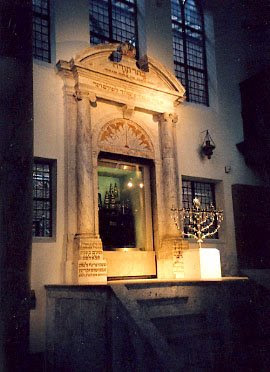
Sephardic Jews expelled from Spain and Portugal during the Inquisition came to Amsterdam. Many were rich merchants with good global business contacts so they were welcomed by the Dutch. A couple of centuries later, the poor Ashkenazi relations arrived in Amsterdam as refugees from Lithuania, Poland and Germany.
The Portuguese connection seemed to be quite strong. The Portuguese synagogue was the largest synagogue in Europe when it was built. In the museum/replica synagogue there’s an imposing oil painting of a Portuguese dude by the name of Soussa. He’s sitting handsomely in a wealthy setting, a sheen of great wealth on his face. He’s holding an orange in his hand to symbolise his acceptance, as a Jew, into the Amsterdam establishment. He seems to be wearing lipstick, I thought. I was fascinated to learn that of the 400 or so plantations owned by the Dutch in the northern part of South America, more than a hundred were owned by Sephardi Jews.
Another interesting Jew who lived in Amsterdam was the philosopher Baruch Spinoza. He was Jewish but didn’t make himself very popular with the Jewish community as he didn’t believe in God. I studied some of Spinoza’s philosophy at university, along with that of all the other philosophers discussed in Bertrand Russell’s “History of Western Philosophy”, which I really enjoyed and read from cover to cover. Spinoza argued in favour of a rather attractive philosophy known as pantheism, according to which the ‘divine’ exists in everything in the natural world, a bit like some Eastern religions such as Buddhism. To most Jews in Amsterdam, though, he was just a trouble-maker and they sort of sent him to Coventry.
Another trouble-maker was a man called Sabbatai Zevi, pronounced Zvee. He was a serious bullshitter who pronounced himself to be the new messiah. Plenty of Dutch and other Jews were taken in and started to worship Zevi. Later, people lost faith in him, particularly when he converted to Isalm under the Ottomans!
Some other items caught my attention in the museum. A sort of flag made out of buttons to advertise the wares of a lady called Sally Polack who, like the great Argentinian bandoneon player El Polaco, must have come from Poland. Lots of little lead seals originally attached to meat as a sign that it was kosher. Photos of poor Jews in Amsterdam in the early twentieth century - hawkers, rag and bone men, matchbox and shoelace sellers all living in poverty in slum conditions.
Duende Dos
That evening we walked across to the western side of the city. It was all a bit more spacious than our hotel area. Big trees in spring leaf hanging over canals, of which there were plenty. We saw people sitting on their front door steps drinking wine, overlooking one of the canals. We passed houseboats large and small. On the deck of one was a huge pot with a lilac tree growing out of it. I had the pleasure of using a ‘pissoir’ for the first time since my visit to Paris at the age of fifteen. It was odd to be urinating while looking out through the metal grille at young people picknicking on a landing stage below on a warm, relaxed spring Sunday evening.
We were heading for a tapas bar called ‘Duende Dos’ on Nieuwe Willemsstraat in the Jordaan (Garden) area of the city. The place was pretty full when we arrived at around 7 o’clock, everybody tucking into their tapas, drinking wine, families, some Spanish, pictures of flamenco dancers on the walls with the word ‘Pasion’ written on them in large letters. A cheerful buzz. As it happens, I’ve been having a bit of a Spanish phase recently. A few weeks ago I went to a concert by the wonderful flamenco guitarist Juan Martin; I’ve been looking again at the BBC ‘Por Aqui’ book to revise my Spanish, I’m learning a tune called Latinish Gypsy on the guitar, been reading ‘Hacienda’ by Lisa St. Aubin de Teran, went to see a film version of Gabriel Garcia Marquez’ “Love in the Time of Cholera”, playing again my Radio Tarifa CDs and, most recently enjoying some TV programmes presented by Andrew Graham-Dixon about Spanish art and culture.
Actually none of these were really reasons for us heading to Duende Dos. Instead, we went to hear the music of a gypsy jazz guitarist born in Vietnam of English parents. His name is Robin Nolan and he’s written the most useful tuition books on gypsy jazz guitar playing. His band was playing later so in the meantime we amused ourselves with a bottle of Rioja, several aceitunas, boquerones, alcochofas, patatas bravas and an ensalada espinacas. Our waitress was so helpful and everything tasted good. At the table behind us was a Spanish slightly extended family. One of the women had a stammer. I’d never heard anyone stammer in Spanish before.
The musicians turned up - two lead jazz guitars, double bass and rhythm guitar played by John Friedrichs. Jacky sat next to his wife and had a good chat. Wonderful music, just the right atmosphere. Sitting with us were two young musician friends of the band. They were students, one studying composition, one a gypsy jazz guitarist, so I bought them a couple of beers. One was from Turkey, the other from Greece, historical enemies but best mates.
During the interval I had a chat with John the rhythm player . He gave me a few tips. I said I practise with a metronome. He said “Do you know how to practise with a metronome?” I said I thought I did but maybe I didn’t. John said that what you have to do is set the metronome going and tap your foot, keep tapping until you get the rhythm in your whole body and only then start playing your chords. John said you have to do this for two hours a day for ten years. That’s what he’d done, anyway. I bought Robin Nolan a beer by way of thanking him for his tuition books. After the interval the band was joined by an alto sax player who was also a fine musician. More or less a perfect European evening.
Johnny Sahib
I woke on Monday morning feeling weird and claustrophobic in our hotel room with no window so went out for a stroll to clear my head. I just wandered around the block, relieved to find that it was a cooler day. Just walking, getting my head together, on a canal bridge when a woman passed on a bike and addressed me in Dutch. I walked on, half awake, and the woman called out “Hey, Johnny, don’t go away. You wanna buy my bike? I don’t really want to sell it but I need some money”.
She looked Indo-Chinese, I imagined her to be from Vietnam but maybe more likely Indonesian, Dutch East Indies. Another consequence of colonialism. I said I didn’t want to buy the bike. She looked me in the eyes and said “You wanna come with me?”, in a quiet Eastern female voice. She was quite pretty in a Dutch East Indies kind of way. “No, my wife’s in the hotel just round the corner, but thanks for asking”.
“Can you give me a few coins, just a little something? I can’t even afford the metro”. I didn’t say “Why do you need the metro when you’ve got a bike?” and gave her a few Euros. She thanked me and we went on our ways, me feeling weirder than ever at the thought conjured up in my mind by this encounter. Especially her calling me Johnny, like Surabaiya Johnny or Johnny Sahib. I reflected on the way that there was still a kind of colonialism in the relationship between the woman and her clients. The same poverty and vulnerability, the same abuse of power. I found it all very sad, as she was probably a heroin addict and had, no doubt, stolen the bike to get some money, a common practise among Amsterdam junkies I think. What a life...Johnny.
Alive, alive-O
I ambled back to the hotel and walked into a broom cupboard next to the door at the bottom of the stairs. A very strange pre-breakfast interlude altogether.
The arrangement at the Hotel France is for guests to take breakfast at the next door establishment, the Molly Malone Irish Pub. As we walked into the dark bar, Sting’s weedy voice came through as piped music. “Message in a Bottle”. Wooden casks lined the walls, labelled ‘Poteen’, ‘Klarenaer’, ‘Jameson’, ‘Paddy’, ‘Korewijn’, ‘Roggenaer’, ‘Taainagel’.
Breakfast was pretty lousy, crappy bread, jam in plastic containers, slabs of processed Gouda, all designed to get lots of people fed with something in as short a time as possible at the lowest possible cost. Good fun, though. Sting moved on to “So Lonely” or was it “Sue Lawley”? An old French couple sat silently beside us. Everything cramped, terrible seating arrangement, surrounded by all things Oirish - a copy of The Irish Times, empty bottles of Hennessy cognac and Coleraine whiskey.
Tucking into a slab of processed Gouda, I made Jack laugh by saying “Well, I’ve already walked into a broom cupboard and been propositioned by a Vietnames prostitute and it’s only breakfast time”.
Button Heaven
Our plan was to go to the Noordemarkt. On our way there we saw the customary array of long-legged young Dutch women bearing down on us from their sit up and beg bikes, plastic flowers adorning their baskets, gingham check plastic seat covers. The longest femurs in the world.
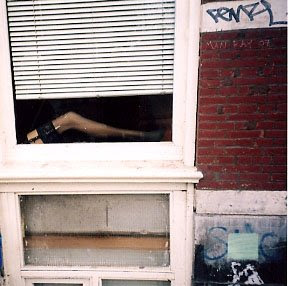
We passed a dusty shop window in which the sole item on display was the severed leg of a mannequin, wearing a black stocking. I took a photo and then noticed that some wag had signed it in chalk on the wall next to the window frame ‘Man Ray ‘07’.
At Noordemarkt we saw a man selling glass and tile cutters. He demonstrated the efficiency of the tool to an enthralled crowd, cutting glass and tiles without a hitch. By the time we got there, he had only small fragments left. The cutters came with a guarantee that there was no way they would work anything like as well when you tried to cut a tile or a sheet of glass at home.
The market consisted, unsurprisigly, of a bewildering mosaic of stalls, some selling clothes, others ‘antiques’.One had the neck of a not very distinguished old guitar for sale, along with a His Master’s Voice type of record player.
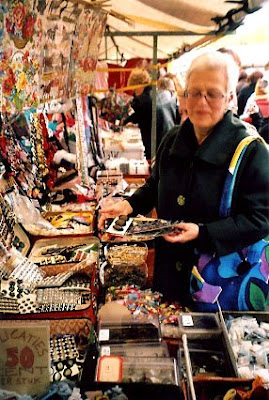
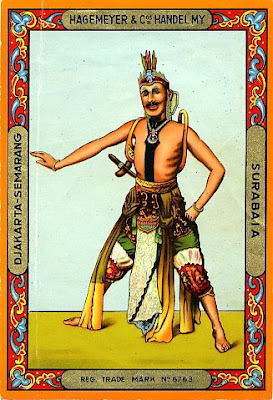
At the button stall, I witnessed Jacky’s Assumption into heaven. All sorts of buttons, mostly round, but not all, different sizes, textures, patterns, finishes, colours. We spent a good half hour there, coming away with 40 Euros worth of buttons, three old postcards and an interesting label which I had bought because it had the word Surabaiya on it.
The Rijksmuseum
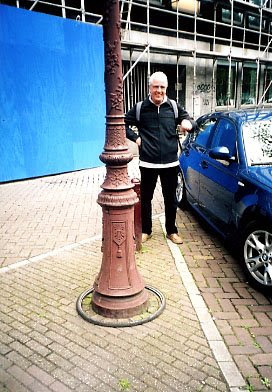
We walked all the way down to the Rijksmuseum. On the way we admired a lamp post which, like most of the others in Amsterdam, had ivy winding round it as part of the ironwork design. This particular lamp post also had a complete bicycle tyre on the ground around it.
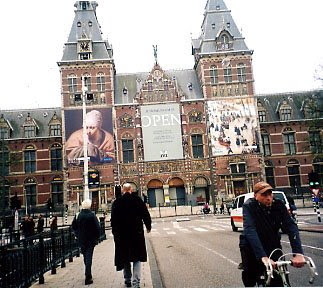
Monday seems to be late-opening day, most of the shops being closed until after lunch. “The Rijksmuseum Is Open”, declared a huge sign on the front of the building. The museum is being refurbished and only one wing of it is open, showing an exhibition of the “Masterpieces” of the collection. The logo for this exhibition was a capital M. Boring or what? Anyway, we didn’t mind seeing only the masterpieces so bought a couple of entry tickets from a nice lady who sneezed violently. I said “Bless you”. She explained that if you sneeze three times in Holland, the sun will shine next day. She added that, in her experience, this never happens.
The first room had written on one of its walls “After the 80 years war (1568-1648), the Dutch expelled their Spanish rulers and established an independent state”. I think the Spanish ruled at that time basically because of marriage with Hapsburgs. During the 80 years war, Amsterdam first supported Spain. Then, after about 10 years, Amsterdam switched allegiance in 1578 in a U-turn known as ‘The Alteration’. After this, the city was very definitely Protestant, as the Reformation spread through most of northern Europe.
The first two paintings I looked at were large canvases of sea battles made using pen and ink. I’d never seen this technique before - it seems to produce a sort of cloudy, ghostly look. Both were painted by Willem van der Welde, an early war-artist who travelled with the Dutch fleet, made sketches as the battles were happening and later worked them up into large paintings in his studio. ‘The Battle of Terheide, painted in 1657, must be at least ten feet wide and about eight feet high. It depicts hundreds of ships, going back into the distance (i.e. higher up on the canvas) and records the blockade that English ships put on Dutch harbours in 1653. During the battle, the Dutch commander Maarten Tromp was killed.
The second of van der Welde’s pen paintings is ‘The Battle of Livorno’, painted a few years after the event in 1655. It shows the English ship ‘Samson’ going up in flames after being hit by a shot from the Dutch man o’ war ‘De Haalve Maan’, captained by Cornelius Tromp. There are masses of English sailors in the water, a jumbled crowd of them tumbling down, some clinging to burning masts. Horrendous. Each figure is carefully represented and, although the painting is several feet wide and high, the figures are each only about three inches tall. On the stern of the ‘Samson’ is a slick graphic motif of ‘The Man In The Moon’...
Then an allegorical painting, 1614, by Adriaen Pieterz van der Verme, depicting the competition between Protestants and Catholics to win the souls of ordinary Dutch people. The Protestants wear black while the Catholics wear monkish habits. The Protestants in their boat, and the Catholics, including a Bishop with his mitre, fish from their boats, using nets to try to catch the peoples’ souls. On the left bank, the Protestant reformers, on the right bank the Papists, the old religion.
In a cabinet we saw some artefacts associated with the Dutch colonial exploits, objects owned or stolen by the merchants of the Dutch East India Company, claimed to be the largets trading company in the world at that time. One of the early multinationals. The object that caught my attention was a slender wooden box about 20 inches long, made in either South India or Sri Lanka, somewhere between 1675 and 1700. The outside surfaces of the box were decorated with finely carved ivory plates. The carved plates were fixed to the box later and mainly showed floral motifs. It was actually a case to contain one of the characteristic long-stemmed pipes that you see in old Dutch paintings. The label said “Dutch merchants smoked their pipes wherever they went”.
The Dutch West India Company, the DWI, is referred to in several of the works on display. The DWI operated in Brasil, Suriname and one or two other places in the Caribbean region, as well as in North America. They traded in furs, gold, sugar and slaves. Something to be proud of.
Next, I studied a painting done in 1680 by Melchior d’Hondecoeter, an artist who specialised in the representation of birds. An undercoater. This picture showed a pelican, some ducks, a casuary, a flamingo and an African crowned crane (as far as I can remember, the national bird of Uganda). The painting was commissioned by stadholder Willem III and was intended for Het Loo Palace, where Willem and Mary had a menagerie of exotic animals.
Then a violin, complete with strings, made of earthenware, faience, around 1705. The violin is covered back, front and sides with the Dutch tile blue. On the belly, a picture of people dancing in a dance hall, on the back a fiddler plays in front of an inn. I started to wonder how resonant it would be if played, and then read the label which said it was just an ornament and not meant to be played.
A beautiful still life of fruit, flowers and shells, painted in 1671 by Balthasar van der Arst. And then an amazing rendition of fine lace in Rembrandt’s 1639 painting of a young woman called Maria Trip. Meindert Hobbema paintings like the landscapes you see from the train between Rotterdam and Amsterdam. When I was 16 one of my favourite paintings was Meindert’s “Road with Poplars”, only seen in not very good reproduction in a Thames and Hudson World of Art book. Lots of roads with poplars in rural Essex, too. Next, a portrait of Ephraim Bueno, a renowned 17th century physician and scholar. I think Ephraim may have been one of the Sephardi Jews.
Next, a most memorable small painting. A little crowd of people stood in front of Vermeer’s “The Kitchen Maid”, transfixed. It was like a magnet, drawing the viewer into its calmness. The only movement in the painting is the stream of milk being poured from a jug. The colours, half blue, half light grey/ochre just sit together and send out a feeling of spiritual balance. Hypnotic.
We looked at some Pieter de Hooch and Paul Sanredam. Jacky said “It’s quite nice to see these paintings of the streets because they’re just like the streets we’ve just walked down”.
In the end I wondered why there were no Breughels. It was because Breughel was Flemish, mostly Belgium, rather than Dutch. I don’t think there are many Breughels in Belgium either. Vienna’s probably best.
The Boulevard of Broken Dreams
That evening, we had a drink outside a cafe in Nieuwmarkt to the sound of a very bad, very loud band playing in the square. On one of the bars in the square was written “Boulevard des Reves Brises”, rather Dylanesque, I thought.
Later we had a meal in an unusually spacious (for Cramsterdam) Vietnamese restaurant on the picaresque Zeedijk. Broken dreams, drunken sailors.
Our Dear Lord in the Attic
The next morning, we had breakfast at Molly Malone’s again, cramped, little elbow room. Bland slices of Edam with boiled eggs, a strange environment full of sleepy people,Sting still straining on “Message in a Bottle”, in his strangulated voice, Sue Lawley again and Desert Island Discs. “In this desert that I call my soul, You always play the starring role”. Melodramatic or what?. Sting would choose all his own songs to take to the desert island.
Jacky deftly pilfered several rolls, eggs, slices of cake that we would need on our journey home. The three Japanese people sitting at our table politely took no notice. They were actually concentrating hard on their fourth and fifth frankfurters and their mounds of scrambled egg. The climax of Jacky’s performance came when she snatched the largest apple, in a daring raid on the fruit bowl, on our way out, dextrously transferring it to her bag to join the other victuals sectreted therein. During breakfast, she also found time to clarify the meaning of the word ‘popinjay’ for me. As I said, I’ve been reading C.J.Samson’s “Sovereign”, which I’d strongly recommend to friends with a historical bent.
We went to see a canalside house where, in 1663, a hosiery merchant called Jan Hartman built a church in his attic. His wife, Lysbeth Jans, came from a family of compass makers. A big demand for compasses at that time.
In the drawing room was a box bed. People didn’t have separate bedrooms in those days and some say that they slept sitting up. It was certainly a very short bed. There was also a cabinet with painted panels depicting scenes in the life of the Prodigal Son, who had “squandered his inheritance and returned home to a loving father”. This reminded us a bit of John. One of the panels showed the son being enthusiastically prodigal, his arm around a young woman, his hand squeezing her bare breast as she holds a glass of wine in her hand while a cellist and a violinist serenade the fun-loving couple.
At the top of the otherwise domestic house was a perfectly formed Catholic church. This was the Reformation yet, in tolerant Amsterdam, the authorities turned a blind eye to Catholics worshipping, even though Catholicism was officially banned. It was OK as long as the building in which they worshipped didn’t look like a Catholic church.
To me, the church looked surprisingly big. Most of the space was taken up by rows of chairs, which could accomodate something like 150 members of a congregation. The altar was ornate. Around the walls hung paintings about ‘The Assumption of the Virgin’ and ‘The Lamentation of Christ’. Some putti, with a label which read ‘Twee Putti’ in Dutch. And a pulpit that could swivel back into a recess behind the altar, to save space.
Behind the altar, we looked into a cabinet that contained three crucifixes in bottles, like ships in bottles. Sting’s breakfast message made flesh. Also, some rosary beads. In Dutch, a rosary is a rosencrantz, apparently. It made me wonder what guildernstern meant. It then made me wonder what ‘Rosencrantz and Guildernstern are Dead’ meant. Did it mean that rosaries are dead, that the Protestants have won? One rosary had large beads in the form of skulls, ten smaller beads in between the larger ones.
We also learnt about the Miracle of Amsterdam which happened in 1345. A sick man had vomited after being given the wafer during his last rites. The vomit, including the eructated body of Christ, was thrown into the fire in the sick man’s house. The wafer, miraculously, refused to burn. This was considered to be seriously meaningful, so much so that the wafer was taken to the Oude Kirke for safe keeping. But, again miraculously, the wafer re-appeared in the house of the sick man. Once again it was taken back to the Oude Kirke. After a while, it turned up once more in the sick man’s house. He couldn’t get rid of it. I don’t know if the sick man died in the meantime, while all this transsubstiation was going on, but I wouldn’t have blamed him. Anyway, this was the Amsterdam Miracle and people from around Holland and further afield started to make pilgrimages to Amsterdam to celebrate the wafer’s strange behaviour. Incredible, really. Still, it was only 1345 and most people were pretty stupid then.
In the two kitchens downstairs were some charming faience tiles on the walls. Blue drawings, thin lines, on off-white backgrounds, Delft blue, just one small figure or an animal in the centre of each tile. Wikipedia explains that “faience is the conventional name in English for fine tin-glazed pottery on a delicate pale buff body. The invention of a pottery glaze suitable for painted decoration, by the addition of an oxide of tin to the slip of a lead glaze, was a major advance in the history of pottery”.
This technique for tin-glazed earthenware was brought to Andalucia by the Moors. Later, some of this was exported from Southern Spain to Italy, often via the island of Majorca, from which majolica gets its name. By the late fifteenth century, tin-glazed earthenware was being made in Italy, particularly in the town of Faenza, the French for which is ‘Faience’. Apparently, “a painted majolica ware on an opaque white ground” was exported from Faenza not long afterwards. Some of this Italian faience was imported by the Dutch, who soon began to make their own, particularly in the town of Delft. Delftware is usually decorated in blue on a white or off-white background. This, in turn, was influenced by the blue and white porcelain that was
imported into Holland from China in the early sixteenth century.
This museumhouse is called the Amstelkring or “On’s Lieve Heer op Solder”, Our Dear Lord in the Attic. It also had a confessional. Today, you can go into the bit where the guilty sinner would have sat and looked through the screen towards a latent peadophile. But you can’t go into the bit where the priest would have sat. A sheet of clear perspex across the front, securing the imbalance of power that has endured through the centuries.
An old dream
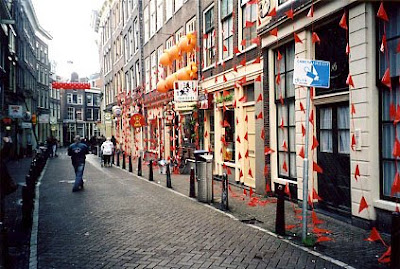
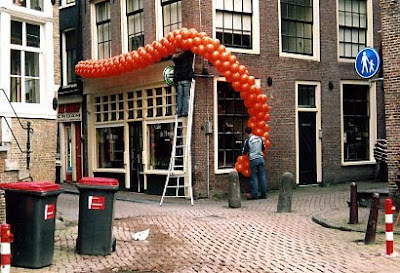
As we left Oudezidjes Kolk, teams of men, in orange overalls, were putting up orange bunting and orange balloons all the way down the Zeedijk, ready for Queen’s Day. On the train going back to Rotterdam, we again saw lots of herons, ditches, dykes and diggers. Between Vlaardingen and Maasluis I noticed a cruise ship with a reproduction of the Mona Lisa printed on its huge funnel. Weird. The ship was named ‘Mona Lisa’. Cruise ship aesthetics.

We arrived at the Hoek in good time so decided to have a quick look round the small town. Would it be a mirror image of Harwich? As we left the station, we were greeted by some sheep.
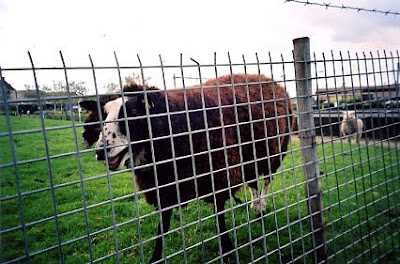
We had a drink in the nearest bar, the Cafe Prins Hendryk. This, for me turned out to be a memorable experience but it’s not easy to explain it well. I had once, or maybe more than once, a dream in which I was in a bar in Holland. I grew up in Harwich and my dad often piloted the ferry to the Hoek of Holland so throughout my childhood there was mention of The Hoek. It’s also to do with illustrations in school text books. Line drawings of Dutch people, a farmer with a cap on and a bulbous, friendly Dutch potato-nose, with canals and windmills and cows in the background, perhaps in a geography book, maybe in the “Learn Dutch!” book that I once got out of the local library circa 1961, maybe avatars of the illustrations in our school French books, schoolboy stereotypes. This sort of stuff all mixed together. I pushed open the door of the Prins Hendryk and there I was, in that dream, those recollections, those fifty year old associations. Not deja vu, though, something quite different. Wonderful.

Old-style, lots of wood, everything wood except the things that were made of brass or glass. A seafaring theme, not even a theme, nothing so self-conscious, just a bar in the Hoek of Holland. I just felt so strongly that my dad had drunk in this place more than once. The barman was one of those line drawings, too. He brought me a beer and the special offer Koffie mit Appelgeback for Jacky. Black and white photographs of old ships and ferries decorated the walls in a way unnecessarily as the whole place was like a ship, like my dream.
As we sat there, me in a sort of happy trance, a fat woman played on a gambling machine, taking deep drags on a cigarette and looking somewhat unhealthy. She was wearing anoutdoor sports type jacket with the word ‘Annapurna’ written on the logo on her sleeve. Wearing her heart attack on her sleeve, I thought, childishly.
A young woman, local, just like Harwich people are in Harwich, confident in their smallworld security, was just going out of the door, in her unsporty grey tracksuit when the barman said something to her, probably about her swollen belly. She turned round sharply and, laughing, proudly displayed her distended body, at which the barman shouted “Sexy!”. Another little Hoek van Hollander on the way.
We wandered out and toward the ferry, noticing some bandy-legged bikers in full leathers and enjoying the signs everywhere that said “Ein Prettige Reis”. We had a pretty journey.
Somewhere in another lifetime...
One of the best friends of my youth was a boy called Gerrard McCaffery. He left school at 15 and got a job on the boats. He passed his driving test on his seventeenth birthday and the next day bought a Jag. Second hand, walnut dashboard, leather seats for the girls. He’d graduated from his Lambretta but was still a Mod. Ben Sherman shirts Pirate Radio off the coast. One summer I had an Austrian girlfriend. I can’t remember her name but I strongly associate that period with Wrigley’s Juicy Fruit chewing gum and ‘Hey Jude’. Take a sad song and make it better. Then I went off to university, discovered a bit of the world and came back to find that Gerrard had taken over the Austrian girl and was about to marry her.
Nearly thirty years later, the phone rang and it was Gerrard, calling from Austria. Quite unexpected and fairly boring. Our friendship had only ever been about being Mods and chewing Juicy Fruit while trying to pick up girls on holiday from the East End in his Jag. By the time he phoned I didn’t do any of those things. All I really remember about the call was him saying something like “I’m quite surprised you’re still alive. I thought you and Hughie Short might have died of drugs or drink by now”. He was a ski instructor.
It was exciting to be going on board. We were a bit early, so we had a drink in the Cliff Hotel in
Dovercourt, then made our way to Parkeston. The football pitch where I often played for Little Oakley against Marine Shops had been concreted over and was now a lorry park edged with wire fencing and searchlights on pylons. As we approached, the security bloke emerged from his kiosk. He looked like he’d watched too many American films. Sunglasses at this time of night? He tried to look as if he was taking us seriously as nautical terrorists - two white-haired people in a respectable family saloon. He directed us, militarily, to our parking place. We embarked some time later, a bit delayed as Jacky became absorbed
looking at a series of embroidered panels made by the womenfolk of Harwich and depicting the town’s history and landmarks in a charmingly naive style. There was, for me, a pleasant familiarity about the whole scene.
I had the top bunk with C.J.Samson and ‘Sovereign’. It was rough getting up there as I hadn’t noticed the ladder. We both slept comfortably and soundly. Before we knew it, we were wandering towards the train at the Hoek at 8 o’clock on a quiet Sunday morning. We had to change at Rotterdam.
Classic landscape from the train. Dykes, cows, distant sharp church spires, the occasional farmhouse, diggers digging ditches, stands of poplars. Opposite us was a living consequence of Dutch colonialism. A young girl with a doll’s face, Indonesian bone structure like Java man. Interesting profile, wearing a hood edged with imitation rabbit fur.
We got to Amsterdam at about ten o’clock. The city’s early success was partly down to a man called Willem Beukelszoon who, in 1385, invented a new way of curing herrings. This meant that the herrings lasted longer before going rotten and so could be exported. Together with the beer trade the herring business helped Amsterdam’s merchants to get the economy going. The rest is history...
Except for dodgy people
Coming out of the station millions of bikes, leant together in rows of Olympian proportions. On the
pavements. We found the Hotel France where it had always been, on the Ouderzijds Kolk, the edge of
Chinatown and the Red Light District. We chose the Hotel France because it was fairly cheap and left our bags there till
check-in time later.
We wandered down the nearest street. Indonesian, Chinese, Vietnamese, Malaysian establishments, an
English Pub with a sign in the window saying “Everybody Welcome Except For Dodgy People”, a bread shop with the word Brood in big letters across its window, a place for foot massage, a gay bar, an Asian Fusion eating house, some souvenir shops, rubbish bags, dog shit, the smell of skunk, long-legged girls on sit up and beg bikes, picaresque and seedy. I read later that this street, the Zeedijk, has seen its fair share of wine, women, drunken sailors and drugs for several centuries. A Bhuddist temple, Chinese Acupuncture, a Scandinavian Pub, Japanese, Portuguese and Greek restaurants, Tapas bars, a shop selling requisites for dope smokers, small tins with pictures of cannabis leaves on their lids.
Entering Nieuwmarkt we saw the last surviving gatehouse of old Amsterdam, a great hulk with turrets, the whole thing built of brick, in 1488. Amazing bricklaying. For some time it was used as a place for weighing market produce and was known as the Waag, which means weigh in Dutch. We sat at a cafe, as you do in European capitals, and had a coffee or, in my case, a glass of hot water. And a green tea bag, separately. Along from us sat a woman wearing high leather boots, a mini-skirt, a blouse unbuttoned to display an expansive cleavage and on top a three quarter length plastic leopard skin coat. She looked like she’d had a hard night.
Joods
We proceeded down St. Antoniesbreestraat, where the Jewish community used to live. They’d never been made to live in a ghetto in Amsterdam. Nearly all the old houses had been knocked down in the 1970s and replaced with uninspiring apartment blocks. We passed smelly coffee shops and Rembrandt’s house, making our way to the Joods Historisch Museum. A man wearing a natty white skullcap came out of a door into the Portuguese synagogue. We carried on into the museum and entered into a reconstructed synagogue. A large Torah scroll unrolled on a lectern, silver jads, long handles of silver with little hands at one end, not backscratchers, used by the cantor to keep his place while reading from the huge Torah. Also on display a set of circumcision instruments.

Sephardic Jews expelled from Spain and Portugal during the Inquisition came to Amsterdam. Many were rich merchants with good global business contacts so they were welcomed by the Dutch. A couple of centuries later, the poor Ashkenazi relations arrived in Amsterdam as refugees from Lithuania, Poland and Germany.
The Portuguese connection seemed to be quite strong. The Portuguese synagogue was the largest synagogue in Europe when it was built. In the museum/replica synagogue there’s an imposing oil painting of a Portuguese dude by the name of Soussa. He’s sitting handsomely in a wealthy setting, a sheen of great wealth on his face. He’s holding an orange in his hand to symbolise his acceptance, as a Jew, into the Amsterdam establishment. He seems to be wearing lipstick, I thought. I was fascinated to learn that of the 400 or so plantations owned by the Dutch in the northern part of South America, more than a hundred were owned by Sephardi Jews.
Another interesting Jew who lived in Amsterdam was the philosopher Baruch Spinoza. He was Jewish but didn’t make himself very popular with the Jewish community as he didn’t believe in God. I studied some of Spinoza’s philosophy at university, along with that of all the other philosophers discussed in Bertrand Russell’s “History of Western Philosophy”, which I really enjoyed and read from cover to cover. Spinoza argued in favour of a rather attractive philosophy known as pantheism, according to which the ‘divine’ exists in everything in the natural world, a bit like some Eastern religions such as Buddhism. To most Jews in Amsterdam, though, he was just a trouble-maker and they sort of sent him to Coventry.
Another trouble-maker was a man called Sabbatai Zevi, pronounced Zvee. He was a serious bullshitter who pronounced himself to be the new messiah. Plenty of Dutch and other Jews were taken in and started to worship Zevi. Later, people lost faith in him, particularly when he converted to Isalm under the Ottomans!
Some other items caught my attention in the museum. A sort of flag made out of buttons to advertise the wares of a lady called Sally Polack who, like the great Argentinian bandoneon player El Polaco, must have come from Poland. Lots of little lead seals originally attached to meat as a sign that it was kosher. Photos of poor Jews in Amsterdam in the early twentieth century - hawkers, rag and bone men, matchbox and shoelace sellers all living in poverty in slum conditions.
Duende Dos
That evening we walked across to the western side of the city. It was all a bit more spacious than our hotel area. Big trees in spring leaf hanging over canals, of which there were plenty. We saw people sitting on their front door steps drinking wine, overlooking one of the canals. We passed houseboats large and small. On the deck of one was a huge pot with a lilac tree growing out of it. I had the pleasure of using a ‘pissoir’ for the first time since my visit to Paris at the age of fifteen. It was odd to be urinating while looking out through the metal grille at young people picknicking on a landing stage below on a warm, relaxed spring Sunday evening.
We were heading for a tapas bar called ‘Duende Dos’ on Nieuwe Willemsstraat in the Jordaan (Garden) area of the city. The place was pretty full when we arrived at around 7 o’clock, everybody tucking into their tapas, drinking wine, families, some Spanish, pictures of flamenco dancers on the walls with the word ‘Pasion’ written on them in large letters. A cheerful buzz. As it happens, I’ve been having a bit of a Spanish phase recently. A few weeks ago I went to a concert by the wonderful flamenco guitarist Juan Martin; I’ve been looking again at the BBC ‘Por Aqui’ book to revise my Spanish, I’m learning a tune called Latinish Gypsy on the guitar, been reading ‘Hacienda’ by Lisa St. Aubin de Teran, went to see a film version of Gabriel Garcia Marquez’ “Love in the Time of Cholera”, playing again my Radio Tarifa CDs and, most recently enjoying some TV programmes presented by Andrew Graham-Dixon about Spanish art and culture.
Actually none of these were really reasons for us heading to Duende Dos. Instead, we went to hear the music of a gypsy jazz guitarist born in Vietnam of English parents. His name is Robin Nolan and he’s written the most useful tuition books on gypsy jazz guitar playing. His band was playing later so in the meantime we amused ourselves with a bottle of Rioja, several aceitunas, boquerones, alcochofas, patatas bravas and an ensalada espinacas. Our waitress was so helpful and everything tasted good. At the table behind us was a Spanish slightly extended family. One of the women had a stammer. I’d never heard anyone stammer in Spanish before.
The musicians turned up - two lead jazz guitars, double bass and rhythm guitar played by John Friedrichs. Jacky sat next to his wife and had a good chat. Wonderful music, just the right atmosphere. Sitting with us were two young musician friends of the band. They were students, one studying composition, one a gypsy jazz guitarist, so I bought them a couple of beers. One was from Turkey, the other from Greece, historical enemies but best mates.
During the interval I had a chat with John the rhythm player . He gave me a few tips. I said I practise with a metronome. He said “Do you know how to practise with a metronome?” I said I thought I did but maybe I didn’t. John said that what you have to do is set the metronome going and tap your foot, keep tapping until you get the rhythm in your whole body and only then start playing your chords. John said you have to do this for two hours a day for ten years. That’s what he’d done, anyway. I bought Robin Nolan a beer by way of thanking him for his tuition books. After the interval the band was joined by an alto sax player who was also a fine musician. More or less a perfect European evening.
Johnny Sahib
I woke on Monday morning feeling weird and claustrophobic in our hotel room with no window so went out for a stroll to clear my head. I just wandered around the block, relieved to find that it was a cooler day. Just walking, getting my head together, on a canal bridge when a woman passed on a bike and addressed me in Dutch. I walked on, half awake, and the woman called out “Hey, Johnny, don’t go away. You wanna buy my bike? I don’t really want to sell it but I need some money”.
She looked Indo-Chinese, I imagined her to be from Vietnam but maybe more likely Indonesian, Dutch East Indies. Another consequence of colonialism. I said I didn’t want to buy the bike. She looked me in the eyes and said “You wanna come with me?”, in a quiet Eastern female voice. She was quite pretty in a Dutch East Indies kind of way. “No, my wife’s in the hotel just round the corner, but thanks for asking”.
“Can you give me a few coins, just a little something? I can’t even afford the metro”. I didn’t say “Why do you need the metro when you’ve got a bike?” and gave her a few Euros. She thanked me and we went on our ways, me feeling weirder than ever at the thought conjured up in my mind by this encounter. Especially her calling me Johnny, like Surabaiya Johnny or Johnny Sahib. I reflected on the way that there was still a kind of colonialism in the relationship between the woman and her clients. The same poverty and vulnerability, the same abuse of power. I found it all very sad, as she was probably a heroin addict and had, no doubt, stolen the bike to get some money, a common practise among Amsterdam junkies I think. What a life...Johnny.
Alive, alive-O
I ambled back to the hotel and walked into a broom cupboard next to the door at the bottom of the stairs. A very strange pre-breakfast interlude altogether.
The arrangement at the Hotel France is for guests to take breakfast at the next door establishment, the Molly Malone Irish Pub. As we walked into the dark bar, Sting’s weedy voice came through as piped music. “Message in a Bottle”. Wooden casks lined the walls, labelled ‘Poteen’, ‘Klarenaer’, ‘Jameson’, ‘Paddy’, ‘Korewijn’, ‘Roggenaer’, ‘Taainagel’.
Breakfast was pretty lousy, crappy bread, jam in plastic containers, slabs of processed Gouda, all designed to get lots of people fed with something in as short a time as possible at the lowest possible cost. Good fun, though. Sting moved on to “So Lonely” or was it “Sue Lawley”? An old French couple sat silently beside us. Everything cramped, terrible seating arrangement, surrounded by all things Oirish - a copy of The Irish Times, empty bottles of Hennessy cognac and Coleraine whiskey.
Tucking into a slab of processed Gouda, I made Jack laugh by saying “Well, I’ve already walked into a broom cupboard and been propositioned by a Vietnames prostitute and it’s only breakfast time”.
Button Heaven
Our plan was to go to the Noordemarkt. On our way there we saw the customary array of long-legged young Dutch women bearing down on us from their sit up and beg bikes, plastic flowers adorning their baskets, gingham check plastic seat covers. The longest femurs in the world.
We passed a dusty shop window in which the sole item on display was the severed leg of a mannequin, wearing a black stocking. I took a photo and then noticed that some wag had signed it in chalk on the wall next to the window frame ‘Man Ray ‘07’.

At Noordemarkt we saw a man selling glass and tile cutters. He demonstrated the efficiency of the tool to an enthralled crowd, cutting glass and tiles without a hitch. By the time we got there, he had only small fragments left. The cutters came with a guarantee that there was no way they would work anything like as well when you tried to cut a tile or a sheet of glass at home.
The market consisted, unsurprisigly, of a bewildering mosaic of stalls, some selling clothes, others ‘antiques’.One had the neck of a not very distinguished old guitar for sale, along with a His Master’s Voice type of record player.

At the button stall, I witnessed Jacky’s Assumption into heaven. All sorts of buttons, mostly round, but not all, different sizes, textures, patterns, finishes, colours. We spent a good half hour there, coming away with 40 Euros worth of buttons, three old postcards and an interesting label which I had bought because it had the word Surabaiya on it.

The Rijksmuseum
We walked all the way down to the Rijksmuseum. On the way we admired a lamp post which, like most of the others in Amsterdam, had ivy winding round it as part of the ironwork design. This particular lamp post also had a complete bicycle tyre on the ground around it.

Monday seems to be late-opening day, most of the shops being closed until after lunch. “The Rijksmuseum Is Open”, declared a huge sign on the front of the building. The museum is being refurbished and only one wing of it is open, showing an exhibition of the “Masterpieces” of the collection. The logo for this exhibition was a capital M. Boring or what? Anyway, we didn’t mind seeing only the masterpieces so bought a couple of entry tickets from a nice lady who sneezed violently. I said “Bless you”. She explained that if you sneeze three times in Holland, the sun will shine next day. She added that, in her experience, this never happens.

The first room had written on one of its walls “After the 80 years war (1568-1648), the Dutch expelled their Spanish rulers and established an independent state”. I think the Spanish ruled at that time basically because of marriage with Hapsburgs. During the 80 years war, Amsterdam first supported Spain. Then, after about 10 years, Amsterdam switched allegiance in 1578 in a U-turn known as ‘The Alteration’. After this, the city was very definitely Protestant, as the Reformation spread through most of northern Europe.
The first two paintings I looked at were large canvases of sea battles made using pen and ink. I’d never seen this technique before - it seems to produce a sort of cloudy, ghostly look. Both were painted by Willem van der Welde, an early war-artist who travelled with the Dutch fleet, made sketches as the battles were happening and later worked them up into large paintings in his studio. ‘The Battle of Terheide, painted in 1657, must be at least ten feet wide and about eight feet high. It depicts hundreds of ships, going back into the distance (i.e. higher up on the canvas) and records the blockade that English ships put on Dutch harbours in 1653. During the battle, the Dutch commander Maarten Tromp was killed.
The second of van der Welde’s pen paintings is ‘The Battle of Livorno’, painted a few years after the event in 1655. It shows the English ship ‘Samson’ going up in flames after being hit by a shot from the Dutch man o’ war ‘De Haalve Maan’, captained by Cornelius Tromp. There are masses of English sailors in the water, a jumbled crowd of them tumbling down, some clinging to burning masts. Horrendous. Each figure is carefully represented and, although the painting is several feet wide and high, the figures are each only about three inches tall. On the stern of the ‘Samson’ is a slick graphic motif of ‘The Man In The Moon’...
Then an allegorical painting, 1614, by Adriaen Pieterz van der Verme, depicting the competition between Protestants and Catholics to win the souls of ordinary Dutch people. The Protestants wear black while the Catholics wear monkish habits. The Protestants in their boat, and the Catholics, including a Bishop with his mitre, fish from their boats, using nets to try to catch the peoples’ souls. On the left bank, the Protestant reformers, on the right bank the Papists, the old religion.
In a cabinet we saw some artefacts associated with the Dutch colonial exploits, objects owned or stolen by the merchants of the Dutch East India Company, claimed to be the largets trading company in the world at that time. One of the early multinationals. The object that caught my attention was a slender wooden box about 20 inches long, made in either South India or Sri Lanka, somewhere between 1675 and 1700. The outside surfaces of the box were decorated with finely carved ivory plates. The carved plates were fixed to the box later and mainly showed floral motifs. It was actually a case to contain one of the characteristic long-stemmed pipes that you see in old Dutch paintings. The label said “Dutch merchants smoked their pipes wherever they went”.
The Dutch West India Company, the DWI, is referred to in several of the works on display. The DWI operated in Brasil, Suriname and one or two other places in the Caribbean region, as well as in North America. They traded in furs, gold, sugar and slaves. Something to be proud of.
Next, I studied a painting done in 1680 by Melchior d’Hondecoeter, an artist who specialised in the representation of birds. An undercoater. This picture showed a pelican, some ducks, a casuary, a flamingo and an African crowned crane (as far as I can remember, the national bird of Uganda). The painting was commissioned by stadholder Willem III and was intended for Het Loo Palace, where Willem and Mary had a menagerie of exotic animals.
Then a violin, complete with strings, made of earthenware, faience, around 1705. The violin is covered back, front and sides with the Dutch tile blue. On the belly, a picture of people dancing in a dance hall, on the back a fiddler plays in front of an inn. I started to wonder how resonant it would be if played, and then read the label which said it was just an ornament and not meant to be played.
A beautiful still life of fruit, flowers and shells, painted in 1671 by Balthasar van der Arst. And then an amazing rendition of fine lace in Rembrandt’s 1639 painting of a young woman called Maria Trip. Meindert Hobbema paintings like the landscapes you see from the train between Rotterdam and Amsterdam. When I was 16 one of my favourite paintings was Meindert’s “Road with Poplars”, only seen in not very good reproduction in a Thames and Hudson World of Art book. Lots of roads with poplars in rural Essex, too. Next, a portrait of Ephraim Bueno, a renowned 17th century physician and scholar. I think Ephraim may have been one of the Sephardi Jews.
Next, a most memorable small painting. A little crowd of people stood in front of Vermeer’s “The Kitchen Maid”, transfixed. It was like a magnet, drawing the viewer into its calmness. The only movement in the painting is the stream of milk being poured from a jug. The colours, half blue, half light grey/ochre just sit together and send out a feeling of spiritual balance. Hypnotic.
We looked at some Pieter de Hooch and Paul Sanredam. Jacky said “It’s quite nice to see these paintings of the streets because they’re just like the streets we’ve just walked down”.
In the end I wondered why there were no Breughels. It was because Breughel was Flemish, mostly Belgium, rather than Dutch. I don’t think there are many Breughels in Belgium either. Vienna’s probably best.
The Boulevard of Broken Dreams
That evening, we had a drink outside a cafe in Nieuwmarkt to the sound of a very bad, very loud band playing in the square. On one of the bars in the square was written “Boulevard des Reves Brises”, rather Dylanesque, I thought.
Later we had a meal in an unusually spacious (for Cramsterdam) Vietnamese restaurant on the picaresque Zeedijk. Broken dreams, drunken sailors.
Our Dear Lord in the Attic
The next morning, we had breakfast at Molly Malone’s again, cramped, little elbow room. Bland slices of Edam with boiled eggs, a strange environment full of sleepy people,Sting still straining on “Message in a Bottle”, in his strangulated voice, Sue Lawley again and Desert Island Discs. “In this desert that I call my soul, You always play the starring role”. Melodramatic or what?. Sting would choose all his own songs to take to the desert island.
Jacky deftly pilfered several rolls, eggs, slices of cake that we would need on our journey home. The three Japanese people sitting at our table politely took no notice. They were actually concentrating hard on their fourth and fifth frankfurters and their mounds of scrambled egg. The climax of Jacky’s performance came when she snatched the largest apple, in a daring raid on the fruit bowl, on our way out, dextrously transferring it to her bag to join the other victuals sectreted therein. During breakfast, she also found time to clarify the meaning of the word ‘popinjay’ for me. As I said, I’ve been reading C.J.Samson’s “Sovereign”, which I’d strongly recommend to friends with a historical bent.
We went to see a canalside house where, in 1663, a hosiery merchant called Jan Hartman built a church in his attic. His wife, Lysbeth Jans, came from a family of compass makers. A big demand for compasses at that time.
In the drawing room was a box bed. People didn’t have separate bedrooms in those days and some say that they slept sitting up. It was certainly a very short bed. There was also a cabinet with painted panels depicting scenes in the life of the Prodigal Son, who had “squandered his inheritance and returned home to a loving father”. This reminded us a bit of John. One of the panels showed the son being enthusiastically prodigal, his arm around a young woman, his hand squeezing her bare breast as she holds a glass of wine in her hand while a cellist and a violinist serenade the fun-loving couple.
At the top of the otherwise domestic house was a perfectly formed Catholic church. This was the Reformation yet, in tolerant Amsterdam, the authorities turned a blind eye to Catholics worshipping, even though Catholicism was officially banned. It was OK as long as the building in which they worshipped didn’t look like a Catholic church.
To me, the church looked surprisingly big. Most of the space was taken up by rows of chairs, which could accomodate something like 150 members of a congregation. The altar was ornate. Around the walls hung paintings about ‘The Assumption of the Virgin’ and ‘The Lamentation of Christ’. Some putti, with a label which read ‘Twee Putti’ in Dutch. And a pulpit that could swivel back into a recess behind the altar, to save space.
Behind the altar, we looked into a cabinet that contained three crucifixes in bottles, like ships in bottles. Sting’s breakfast message made flesh. Also, some rosary beads. In Dutch, a rosary is a rosencrantz, apparently. It made me wonder what guildernstern meant. It then made me wonder what ‘Rosencrantz and Guildernstern are Dead’ meant. Did it mean that rosaries are dead, that the Protestants have won? One rosary had large beads in the form of skulls, ten smaller beads in between the larger ones.
We also learnt about the Miracle of Amsterdam which happened in 1345. A sick man had vomited after being given the wafer during his last rites. The vomit, including the eructated body of Christ, was thrown into the fire in the sick man’s house. The wafer, miraculously, refused to burn. This was considered to be seriously meaningful, so much so that the wafer was taken to the Oude Kirke for safe keeping. But, again miraculously, the wafer re-appeared in the house of the sick man. Once again it was taken back to the Oude Kirke. After a while, it turned up once more in the sick man’s house. He couldn’t get rid of it. I don’t know if the sick man died in the meantime, while all this transsubstiation was going on, but I wouldn’t have blamed him. Anyway, this was the Amsterdam Miracle and people from around Holland and further afield started to make pilgrimages to Amsterdam to celebrate the wafer’s strange behaviour. Incredible, really. Still, it was only 1345 and most people were pretty stupid then.
In the two kitchens downstairs were some charming faience tiles on the walls. Blue drawings, thin lines, on off-white backgrounds, Delft blue, just one small figure or an animal in the centre of each tile. Wikipedia explains that “faience is the conventional name in English for fine tin-glazed pottery on a delicate pale buff body. The invention of a pottery glaze suitable for painted decoration, by the addition of an oxide of tin to the slip of a lead glaze, was a major advance in the history of pottery”.
This technique for tin-glazed earthenware was brought to Andalucia by the Moors. Later, some of this was exported from Southern Spain to Italy, often via the island of Majorca, from which majolica gets its name. By the late fifteenth century, tin-glazed earthenware was being made in Italy, particularly in the town of Faenza, the French for which is ‘Faience’. Apparently, “a painted majolica ware on an opaque white ground” was exported from Faenza not long afterwards. Some of this Italian faience was imported by the Dutch, who soon began to make their own, particularly in the town of Delft. Delftware is usually decorated in blue on a white or off-white background. This, in turn, was influenced by the blue and white porcelain that was
imported into Holland from China in the early sixteenth century.
This museumhouse is called the Amstelkring or “On’s Lieve Heer op Solder”, Our Dear Lord in the Attic. It also had a confessional. Today, you can go into the bit where the guilty sinner would have sat and looked through the screen towards a latent peadophile. But you can’t go into the bit where the priest would have sat. A sheet of clear perspex across the front, securing the imbalance of power that has endured through the centuries.
An old dream


As we left Oudezidjes Kolk, teams of men, in orange overalls, were putting up orange bunting and orange balloons all the way down the Zeedijk, ready for Queen’s Day. On the train going back to Rotterdam, we again saw lots of herons, ditches, dykes and diggers. Between Vlaardingen and Maasluis I noticed a cruise ship with a reproduction of the Mona Lisa printed on its huge funnel. Weird. The ship was named ‘Mona Lisa’. Cruise ship aesthetics.

We arrived at the Hoek in good time so decided to have a quick look round the small town. Would it be a mirror image of Harwich? As we left the station, we were greeted by some sheep.

We had a drink in the nearest bar, the Cafe Prins Hendryk. This, for me turned out to be a memorable experience but it’s not easy to explain it well. I had once, or maybe more than once, a dream in which I was in a bar in Holland. I grew up in Harwich and my dad often piloted the ferry to the Hoek of Holland so throughout my childhood there was mention of The Hoek. It’s also to do with illustrations in school text books. Line drawings of Dutch people, a farmer with a cap on and a bulbous, friendly Dutch potato-nose, with canals and windmills and cows in the background, perhaps in a geography book, maybe in the “Learn Dutch!” book that I once got out of the local library circa 1961, maybe avatars of the illustrations in our school French books, schoolboy stereotypes. This sort of stuff all mixed together. I pushed open the door of the Prins Hendryk and there I was, in that dream, those recollections, those fifty year old associations. Not deja vu, though, something quite different. Wonderful.

Old-style, lots of wood, everything wood except the things that were made of brass or glass. A seafaring theme, not even a theme, nothing so self-conscious, just a bar in the Hoek of Holland. I just felt so strongly that my dad had drunk in this place more than once. The barman was one of those line drawings, too. He brought me a beer and the special offer Koffie mit Appelgeback for Jacky. Black and white photographs of old ships and ferries decorated the walls in a way unnecessarily as the whole place was like a ship, like my dream.
As we sat there, me in a sort of happy trance, a fat woman played on a gambling machine, taking deep drags on a cigarette and looking somewhat unhealthy. She was wearing anoutdoor sports type jacket with the word ‘Annapurna’ written on the logo on her sleeve. Wearing her heart attack on her sleeve, I thought, childishly.
A young woman, local, just like Harwich people are in Harwich, confident in their smallworld security, was just going out of the door, in her unsporty grey tracksuit when the barman said something to her, probably about her swollen belly. She turned round sharply and, laughing, proudly displayed her distended body, at which the barman shouted “Sexy!”. Another little Hoek van Hollander on the way.
We wandered out and toward the ferry, noticing some bandy-legged bikers in full leathers and enjoying the signs everywhere that said “Ein Prettige Reis”. We had a pretty journey.
Tuesday, 21 August 2007
Songlines and Sausages
I Am The Path
We took a bus from the airport into Schwedenplatz, alongside the Danube Canal. Round the corner is the Post Hotel on a street called Fleisch Markt, not far from the headquarters of Vienna's postal service. We checked into the Post and, up in our spacious room, read that, over the years, Mozart, Haydn, Janascek and Nietzche had all lived in houses on this site. It seemed a good spot.
On our way to meet Jacky's aunt we saw a big slogan sprayed on a wall - "Stop The War On Drugs". This was mildly puzzling. Next there was a fine example of the art of stencil graffiti in the form of a large, black, well-defined fish which we admired for a couple of minutes before continuing on our way.
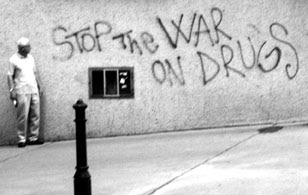
Edith Elias and Fritz Gerrard were married more than sixty years ago. They lived together in the same apartment on Untereweissgerber Strasse from 1949 until March of this year, when Fritz passed away. The flat is in a typical Viennese apartment block. High ceilings, parquet floors, plenty of room for two, some serious furniture and a grand piano. They used to have a lady who cooked for them, called Frau Mitzi, whose unforgettable plum dumplings I once sampled.
Fritz has sufferred from a degenerative illness since the late 1970s, his mobility declining until, in recent years, he had to use a wheelchair and then, finally, became unable to leave the apartment. He put up with all this with great dignity and seldom complained. Fritz liked facts. He enjoyed reading popular science. He and I shared a liking for the books of Richard Dawkins.
Edith, at the age of 85, is still very much in demand at the Viennese law courts, where she is a legal translator. She usually works on asylum or drugs cases, most involving Nigerians on legal aid. She is very experienced in this work although has no legal qualifications. This does not stop her from giving advice to both highly qualified lawyer and heavy heroin dealer. "Now, you've got to understand. You're committing murder by instalment. Think about it - it's not a good way for a young man to spend his life".
We walked a couple of hundred metres along her street to the restaurant at the Hundertwasser Kunsthaus. Hundertwasser was a wonderful graphic artist who shaped this large house as a space in which to show his work. The building now contains no straight lines and has a lovely organic feel, brightly coloured ceramic tiles forming rounded shapes on walls, columns and any other handy surface. I was really impressed with Hundertwasser's work when I first saw it back in the mid 70s. Edith is a regular at the restaurant and good friends with the man who holds the lease. "He's in terrible financial trouble", she explained. "He owes a lot of money in unpaid tax". Apparently this guy spent 700,000 schillings on flowers and plants when the restaurant opened. She thinks he won't last more than a few months. She also told us that the Kunsthaus itself was sold to the Vienna Corporation for one euro after Hundertwasser died about ten years ago. This was also to do with unpaid tax. Anyway, Edith comes here often as it's just down the road and she can get her favourite food, croquet potatoes.
Edith has been reading Bruce Chatwyn's 'Songlines' and made several references to her concept of songlines over supper. Talking about the path of her long life, she said "That's my songline, you see" and, of others, "That's where their songlines crossed over". She is also very aware of the constant change that carries us through our lives and how we are different people at different times. A bit like not being able to step twice into the same river, as Heraclitus put it. She also explained that she thinks a bit like Eastern philosophers who talk about the journey being more important than the arrival. (They never flew on Ryan Air). Her perception of all this, now, is that she is more than just the journey. "I am the path", she announced as her croquet potatoes arrived.
After the meal, and further stimulating conversation, we walked back to the Hotel Post where I noticed lines of thin wire spikes sticking up from all its window ledges. No Perching.
Good Breeding
Vienna has wonderful, imposing architecture in abundance. Many of the buildings, with their double-headed imperial eagles, were, formerly, palaces because of Vienna's position as capital of the Austro-Hungarian empire. The emperors all came from the von Hapsburg dynasty, starting with Rudolf in 1278. The empire lasted until after the first World War. One of the reasons for this endurance was that the Hapsburgs consistently allied themselves through marriage with other powerful European families. That's good breeding.
For several centuries the Austro-Hungarian empire covered much of Europe and managed, on various occasions, to stop the Turks from moving into Europe. The Turks attacked Vienna itself in 1529 but the central part of the city, the Innere Stadt, was successfully defended. The Turks attacked again in 1683 and were again defeated.
Leopold was emperor when most of the great Baroque architecture and music was created in Vienna. Maria-Theresa (1740-80) also found time to encourage Mozart and Haydn, despite having sixteen children. In 1805, Napoleon turned up on his way to Austerlitz and was accomodated at Maria-Theresa's former palace at Schonbrun. After Napoleon had finished his warring and fighting, the Congress of Vienna took place in 1815, during which Europe was carved up into new spheres of power.
The empire prevailed. The last emperor, Franz Josef, ruled for sixty eight years from 1848 until the end of the empire in 1916. He must have suffered terrible grief in his life. His son committed suicide in Mayerling, his wife was assasinated in Geneva and his other son, the Archduke Franz Ferdinand von Hapsburg was famously shot in Sarajevo, the event triggering the first World War.
Expressiv! at the Albertina
Walking through the centre of Vienna I noticed some well designed skulls carved on tombstones on the front wall of the Stephansdom. We passed Kapuzin House where most of the Hapsburgs are buried. We saw fiacres, young men dressed and hairstyled like Mozart, chocolate Mozart balls and posters showing Mozart's silhouette. Poor old Mozart himself lived and died more or less a pauper. One of the greatest crimes against humanity.
We were on our way to a beautiful art gallery in the Albertina Palace, founded in 1781 and named after Maria Theresa's son-in-law Duke Albert of Saxony-Teschen. The exhibition was called Expressiv! First we had a drink in the cafe. My tea came in the form of a Darjeeling tea bag and a glass teapot containing hot water. That was a first for me, the glass teapot. We took our time, looking across at the imposing imperial buildings, roofs and eagles green with verdigris. Across to our left was a huge statue of Feldmarschall Erzherzog Albrecht von Oesterreich (1817 - 95) on horseback.

Inside the Albertina we walked through a white marble hall of mirrors, lots of Jackys everywhere. In a spacious side room, again white, classical and hyper-refined, were ten statues of the Greek Muses and an amazingly ornate candelabra. We gave the Prunkraume a miss, not liking the name very much.
The exhibition was an unusually extensive one about the artists who belonged to the Kunstlergruppe 'Die Brucke' - 'The Bridge'. It included many works from the private collection of a man called Hermann Gerlinger. The Brucke group was founded in Dresden by Ludwig Kirchner, Karl Schmitt-Rotluff and friends in 1905. Max Pechstein and Emil Nolde joined in the following year. The group's manifesto was refreshingly idealistic, including statements like "We intend to obtain freedom of action and of life against the well-established older forces". Still quite a good idea.
It's one of life's rare treats to have nothing to do but wander around a large art gallery on a weekday morning. I loved Schmitt-Rotluff's 'Morgen an der Elbe', Nolde's 'Boot Im Scilf' (Boat in the Reeds') and Kirchner's woodcut 'In Einem Atelier, 1905'. A couple of Kirchner's wood printing blocks were on display. He took prints from both sides of the block, presumably for reasons of economy. In German, these double-sided panels are called 'Doppelseitiger Holzstock'. One of Nolde's colour lithographs shows a group of people in a bar with a piano. It's called "Tingel-Tangel", which was translated as "Honky-Tonk". Jacky drew a thumbnail sketch of Kirchner's "Tanzarin mit Gehobenem Rock" - "Dancer with a Raised Skirt".
We enjoyed Heckel's woodcuts of figures with mask-like heads at right angles to their bodies, Kirchner's "Bathing Scene with Hanging Branches", Schmitt-Rotluff's "Woman with Open Hair" (Aufgelostren Haar). Several of the works showed influences from African tribal art and from Gauguin, like whom most of the artists here seem to have shared thoughts about freedom, noble savages and nubile young brown girls. The last room was taken by Otto Mueller, whose paintings almost exclusively depicted female nudes, euphemistically referred to as 'bathers', lolling about in Arcadian tropical paradises. This rather confirmed our suspicions that the delightful paintings we had been admiring were strongly imbued with a sort of northern European male fantasy.
"There don't seem to be any noble savage blokes", I observed.
"No", replied Jacky, "And there aren't any old people either".
Despite this, we had both found the exhibition rather beautiful and happy. I was, however, jolted out of this happy state on reading about what happened to Kirchner. After a short time in a military unit, the sensitive Kirchner was freaked out by the idea of violence and shooting guns. In 1917, the information sheet informed us, Kirchner "retired to absolute solitude, living in an alpine hut on the Stafelalp". Later, after the Nazis had become popular, Kirchner's paintings were pronounced to be "un-German". In a letter from the 1930s, he had written "War is in the air. In the museums, the culture that has been achieved with great effort over the past twenty years is now being destroyed". On the 15th of June, in 1938, Ludwig Kirchner shot himself. He had become addicted to alcohol during the First World War.
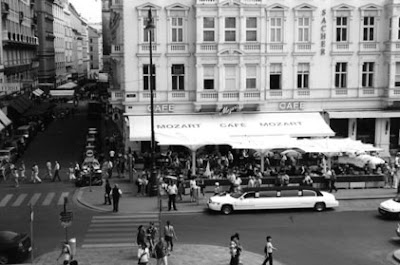
We met Edith for lunch at the Mozart cafe opposite the Albertina not far from a series of sculptures made as a 'Memorial Against War and Fascism'. I was disappointed that we arrived too late for the lunch of the day, Rindsuppe mit Champignonschoberl followed by Schweinskarreebraters im Krautermantel mit Erdapfelgratin. Instead I had a typical Viennese meal of three kinds of Austrian sausages, two jars of mustard and a pot of vicious grated horseradish.
Beschwipserl In The Judenplatz
The information board for the Memorial Against War and Fascism read 'After 12 May 1938 Jewish citizens of Vienna were forced to scrub the streets that had been smeared with slogans'. One element of the memorial is a life-size bronze figure of a crouching Jewish man, presumably scrubbing the pavement with a toothbrush. On his back are some lengths of barbed wire, suggesting to me the concentration camp. But no. "They put the barbed wire there to stop people sitting on it", Edith explained. She said sometimes when you talk about this period Viennese people say "Oh, why are you going on about that - it was a long time ago, I wasn't around when that happened". Edith usually responds something like "Well, you weren't around when Mozart was alive but you don't mind talking about him".
I glugged on my glass of red wine and Edith promptly explained that the Austrian word for tipsy is 'beschwipserl'. Makes you wobble just to say it and onomatapoeic as well. After lunch we wandered through the city, stopping for a schnapps at the Lederhof tavern. Round the corner was the Judenplatz, the heart of the former Jewish area, where two hundred Jews were burned alive in 1421. Some sort of barbecue. During this particular pogrom, the Vienna synagogue was dismantled and its stones used to build part of the university. Jews were expelled from the city for a couple of centuries until in the 1620s they were allowed to come back and settle in a ghetto on marshland by the Danube in Leopoldstadt.
1938 was the annus horribilis, the year of the 'Kristallnacht' pogrom, when twenty three of the city's twenty four synagogues were smashed up, along with all Jewish shops, windows shattered, and many Jewish homes. On March 13, Hitler drove triumphantly into Vienna, to the cheers of several hundred thousand Austrians. They were celebrating the 'Anschluss', the German annexation of Austria.
There were about 180,000 Jews living in Vienna at that time. 65,000 of them were killed. One of them, Rella Eltes, was Jacky's paternal grandmother. One day in 1938, the SS visited her apartment. They took Rella and her husband, Josef, away. Jacky's dad Erwin and his brother 'Uncle Fred', then aged 15 and 16, were left behind in the flat to wait, worry and wonder. After a day or two their father returned. Rella had been detained and they never saw their mother again. Jacky's dad had a nervous breakdown at the age of twenty. The main charge against Rella was that she had lined her underwear drawer with an old newspaper on which there was a photograph of Hitler. "You have insulted the Fuhrer by putting your nasty Jewish knickers on his photograph". Rella died in a concentration camp, possibly Belsen, possibly Auschwitz, possibly an establishment near the French border. We are not sure. Erwin, Fred and their father made their way, after many months of travel across Europe, on a journey that took in Marseilles, to England. They were interned on the Isle of Man, just in case they were enemy aliens. Yeah, highly likely....
Jacky's parents always said that the Austrians behaved even worse than the German Nazis. The Berlitz Pocket Guide to Vienna says that "The expulsion and extermination of the Jews left a great stain on the city and a gaping hole in the cosmopolitan culture in which the Jews had played such an important role". A great stain. Rella's spotlessly clean knickers on Hitler's dirty face.
There is a memorial in the Judenplatz to the sixty five thousand Viennese Jews killed by the Nazis. It is a large cube of concrete which you could be forgiven for mistaking for a public convenience. It is actually a powerful work of art by Rachel Whiteread. It is an idea, set into a concrete reality, that reverberates around your mind for a long time afterwards. It's like a library, rows of concrete books on concrete shelves, but with their spines on the inside, so you see only the opposite edges to the spines. You cannot see their titles. You do not know the names of their authors. At the front of the cube are two large concrete doors which have no handles. This is a library that you can never enter. You can discover nothing about the people who wrote these books, these lives, these memories, feelings, experiences. But you will know that they were there.
On the way back to the Post we passed the Greek Orthodox Church along the Fleisch Markt. A lovely, Byzantine building, on the ground floor of which is a shop. Orient Teppisches. S.P. Issakides, Import Export. "Oh yes", said Edith, "Mr. Issakides was one of Pappi's best customers". Edith's father had traded in oriental carpets. He ran away from his home in Baghdad ( as lots of people are doing now) to Istanbul and later moved to Vienna where he met Mutti, Edith's mother, who was working in a shoe shop.
Later, we went round to Edith's flat and had sauerkraut with Frankfurters. I tried on several pairs of Fritzl's shoes. None of them were right. A bit strange putting on the shoes of a man who couldn't walk.
Minerals and Deathsuckers
More skulls the next morning. Two young men came into the breakfast room dressed identically in shorts and black t-shirts on which there were white skulls, crossed swords and the words 'Naked Riders'.
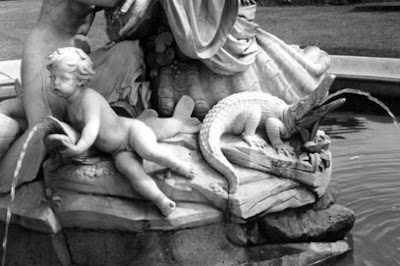
We passed Goethe on the tram to the Kunsthistorisches Museum, at the bottom of Goethegasse. He was covered in verdigris like the statues in London are covered in bird lime. Harry Lime. Getting off the tram we saw lots of people smoking as they walked along in the fresh air. "They're sucking on death", Jacky observed. Deathsuckers. I took a snap of a crocodile at the base of a fountain and noticed, also, that Anthony Gormley had been busy installing standing figures on the top of the museums.
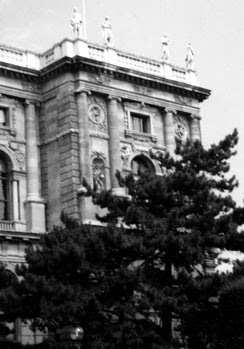
We went first to the Naturhistor Museum. Jacky wanted to show me the stones that make up the marvellous Systematische Mineraliensammlung, the systematic minerals collection. It must have contained many thousand bits of rock, most about the size of a fist, all displayed in wood-framed glass cases, dozens of which ran, in serried ranks, across several rooms. At first sight, it all looked incredibly boring. But when I started looking carefully, it gradually became totally amazing. Things like a psychedelic block of malachite next to a huge lump of translucent aragonite which looked as if it should have been in a bathroom.
In one room there was a large block of pale pinky-orange material, as tall as me, entitled 'Steinsalz von Pendjab. Geschenk des Hrn. T. Oldham in Calcutta 1873'. It reminded me of a poster made at a workshop I did with art students in the Punjab. Chandigarh 1985. Many people in the southern part of the Punjab could only get very saline water to drink from their wells. Prolonged drinking of this water gave people pains in their joints, back ache, bladder stones and yellow teeth. I was looking at a small part of the problem. It was pinky-orange. Next to it stood an even taller obelisk of salt from the Banya Saline Mine. Then bright yellow smithsonite from Sardinien and magenta spharocobaltit from Shaba , Zaire. Rhodocrosite from Mine Capillitas, Argentina, azurit from Medjankes in Poland. Malachite that looked like a brain, from Falkenstein in the Tirol, more malachite from Burra Burra in Australia, from Katanga in the Congo, from Durango in Mexico, Guangdong in China, Tsumeb in SW Africa, Siberien in the USSR, Arizona and Elba. Malachite everywhere.
Incredible what the earth is made of, such diversity. Some charming pieces of baryt from Frizington in England. A football-sized geode of coelestin from the Vallee de la Sofia in Madagaskar. Turquoise and azure blue krohnkit from Chuquicamata in Chile. A huge block of gypsum from Utah and a small, pale yellow piece of beaverit from Beaver County, also in Utah. A knob of krokoit from Congohas do Campo in Brasil. Metavoltin from Madeni Zakh in Persia. Olivenite from Redruth in Cornwall next to herderit from Gilgit in Pakistan next to vayrywenit from Viitaniemi in Finland. Lime green pyromorphit from Roughtengills in England, gypsum with hoar-frost on it from Murcia in Spain, babingtonite from Zhougguo in China, hiddenit from Nuristan in Afghanistan, apatite from Salzburg, vivianite from Anoua in Cameroon, lazulith auf quartz from Big Fish, Yukon, Canada, sapphirius from Bakersville, North Carolina and nephritic jade from British Columbia. Fluorescent aragonite from Derbyshire and anglesit from Leadhills in Scotland, all fluorescing in glorious technicolour - yellow, orange, blue-violet.
I was pretty 'stoned' by the time I reached Saal IV, another palatial room with a parquet floor and decorated ceiling. Around the upper part of the walls were twenty large, legless figures each holding a big crystal, a lump of rock or supported by an outcrop of quartz or examining slabs of granite. The sculptor must have had a great time. In between the statues were grand paintings of landscapes showing different types of rock in their natural environment.
That was the only Natural History Museum I've visited without seeing a single plant or animal. They were there, of course, but we were full up with minerals.
In Breughel's Room
One of Vienna's greatest treasures is the Breughel room in the Kunsthistorisches Museum. Despite being full up with stones, we needed a quick shot of Breughel. On the way, we looked at Breughel's son Jan the Elder's painting of a vase of flowers against a black background. It shows around 130 different types of flower. Before farmers started using chemical sprays. Round the corner were some Archimboldos including 'Wasser', a face made up of eels, crabs, fish, lobsters, octopi and squid. He'd have loved Photoshop. I was surprised to learn that Archimboldo had been appointed court painter, in 1562, for Vienna and Prague.
Pieter Breughel lived in The Netherlands, some of which we saw from our KLM flights into and out of Amsterdam on the way here, between about 1525 and 1569. So, he died when Shakespeare was five. His room is absolutely awesome but still very human and comforting. That feeling of being in the presence of something great. 'Hunters In The Snow', blue lead grey icy colours, hunters returning to their village with knackered dogs and just a single dead fox. Cold crows in beautifully painted bare branches dark against the wintry sky. The landscape spreading itself out below the hill in the foreground, on which a bramble seems to be shooting out defiantly, as if spring were coming. Looking as close at it as I could (Jacky had already been told off for drinking out of her mineral water bottle) I could see for miles and miles to the furthest village.
Then the wonderful and wonderfully entitled 'The Gloomy Day'. One of those days when you just don't want to get out of bed. A few blokes half-heartedly pollarding willows or gathering faggots for the fire. A day to be endured. One of the six seasons in Breughel's series about the rolling round of the year. Then the 'Turmbau zu Babel' where all the languages of the world are spoken, so much confusion that the builders can't finish their work. The famous 'Kinderspiele' in which two hundred and thirty children are painted playing eighty three different games. "The Fight Between Carnival and Lent', two halves of human nature. At Carnival time a pig roasting on a spit, a man playing a guitar. In Lent only fish and cripples, beggars, blind men, polio victims, amputees. A tavern on the left, a church on the right. The "Bauern Tanz', the peasant dance, podgy bagpiper, couples leaping, getting pissed in the warm glow of a country fair. And, of course, the most famous of all 'Bauernhochzeit', a high old time at the 'Peasant's Wedding'. According to Flemish tradition, the bridegroom was not invited to the wedding feast. Saal X.
Leberknodel at the Prater
Third Man territory. Big wheel, big meadow, pasture, prater so Edith says. This is near where she lived until she was ten. She had spent that morning in prison talking to a Sierra Leonean heroin dealer/addict and his legal aid lawyer. We had lunch outside at the park restaurant, hot and sunny. I thought I'd try the Rindsuppe mit Leberknodel mainly because of the words. Edith explained that the knodel, or dumpling, was made from the liver and lung of a cow. It was fine for a vegetarian.
And that was about it. That evening we were confined to barracks because of a long-lasting thunderstorm. We sat in the bar of the Hotel Post with the windows open to try and cool the place down a bit while the rain poured down against the light from the streetlamps on Fleisch Markt. On the flight back, I finished 'Don Quixote' which I had started several weeks and 940 pages ago.
Edith goes on being the path. We bring our songlines back with us and, sitting here at home I try to imagine how lonely it must be at number 17/12 Untereweissgerber Strasse.
We took a bus from the airport into Schwedenplatz, alongside the Danube Canal. Round the corner is the Post Hotel on a street called Fleisch Markt, not far from the headquarters of Vienna's postal service. We checked into the Post and, up in our spacious room, read that, over the years, Mozart, Haydn, Janascek and Nietzche had all lived in houses on this site. It seemed a good spot.
On our way to meet Jacky's aunt we saw a big slogan sprayed on a wall - "Stop The War On Drugs". This was mildly puzzling. Next there was a fine example of the art of stencil graffiti in the form of a large, black, well-defined fish which we admired for a couple of minutes before continuing on our way.

Edith Elias and Fritz Gerrard were married more than sixty years ago. They lived together in the same apartment on Untereweissgerber Strasse from 1949 until March of this year, when Fritz passed away. The flat is in a typical Viennese apartment block. High ceilings, parquet floors, plenty of room for two, some serious furniture and a grand piano. They used to have a lady who cooked for them, called Frau Mitzi, whose unforgettable plum dumplings I once sampled.
Fritz has sufferred from a degenerative illness since the late 1970s, his mobility declining until, in recent years, he had to use a wheelchair and then, finally, became unable to leave the apartment. He put up with all this with great dignity and seldom complained. Fritz liked facts. He enjoyed reading popular science. He and I shared a liking for the books of Richard Dawkins.
Edith, at the age of 85, is still very much in demand at the Viennese law courts, where she is a legal translator. She usually works on asylum or drugs cases, most involving Nigerians on legal aid. She is very experienced in this work although has no legal qualifications. This does not stop her from giving advice to both highly qualified lawyer and heavy heroin dealer. "Now, you've got to understand. You're committing murder by instalment. Think about it - it's not a good way for a young man to spend his life".

We walked a couple of hundred metres along her street to the restaurant at the Hundertwasser Kunsthaus. Hundertwasser was a wonderful graphic artist who shaped this large house as a space in which to show his work. The building now contains no straight lines and has a lovely organic feel, brightly coloured ceramic tiles forming rounded shapes on walls, columns and any other handy surface. I was really impressed with Hundertwasser's work when I first saw it back in the mid 70s. Edith is a regular at the restaurant and good friends with the man who holds the lease. "He's in terrible financial trouble", she explained. "He owes a lot of money in unpaid tax". Apparently this guy spent 700,000 schillings on flowers and plants when the restaurant opened. She thinks he won't last more than a few months. She also told us that the Kunsthaus itself was sold to the Vienna Corporation for one euro after Hundertwasser died about ten years ago. This was also to do with unpaid tax. Anyway, Edith comes here often as it's just down the road and she can get her favourite food, croquet potatoes.
Edith has been reading Bruce Chatwyn's 'Songlines' and made several references to her concept of songlines over supper. Talking about the path of her long life, she said "That's my songline, you see" and, of others, "That's where their songlines crossed over". She is also very aware of the constant change that carries us through our lives and how we are different people at different times. A bit like not being able to step twice into the same river, as Heraclitus put it. She also explained that she thinks a bit like Eastern philosophers who talk about the journey being more important than the arrival. (They never flew on Ryan Air). Her perception of all this, now, is that she is more than just the journey. "I am the path", she announced as her croquet potatoes arrived.
After the meal, and further stimulating conversation, we walked back to the Hotel Post where I noticed lines of thin wire spikes sticking up from all its window ledges. No Perching.
Good Breeding
Vienna has wonderful, imposing architecture in abundance. Many of the buildings, with their double-headed imperial eagles, were, formerly, palaces because of Vienna's position as capital of the Austro-Hungarian empire. The emperors all came from the von Hapsburg dynasty, starting with Rudolf in 1278. The empire lasted until after the first World War. One of the reasons for this endurance was that the Hapsburgs consistently allied themselves through marriage with other powerful European families. That's good breeding.
For several centuries the Austro-Hungarian empire covered much of Europe and managed, on various occasions, to stop the Turks from moving into Europe. The Turks attacked Vienna itself in 1529 but the central part of the city, the Innere Stadt, was successfully defended. The Turks attacked again in 1683 and were again defeated.
Leopold was emperor when most of the great Baroque architecture and music was created in Vienna. Maria-Theresa (1740-80) also found time to encourage Mozart and Haydn, despite having sixteen children. In 1805, Napoleon turned up on his way to Austerlitz and was accomodated at Maria-Theresa's former palace at Schonbrun. After Napoleon had finished his warring and fighting, the Congress of Vienna took place in 1815, during which Europe was carved up into new spheres of power.
The empire prevailed. The last emperor, Franz Josef, ruled for sixty eight years from 1848 until the end of the empire in 1916. He must have suffered terrible grief in his life. His son committed suicide in Mayerling, his wife was assasinated in Geneva and his other son, the Archduke Franz Ferdinand von Hapsburg was famously shot in Sarajevo, the event triggering the first World War.
Expressiv! at the Albertina
Walking through the centre of Vienna I noticed some well designed skulls carved on tombstones on the front wall of the Stephansdom. We passed Kapuzin House where most of the Hapsburgs are buried. We saw fiacres, young men dressed and hairstyled like Mozart, chocolate Mozart balls and posters showing Mozart's silhouette. Poor old Mozart himself lived and died more or less a pauper. One of the greatest crimes against humanity.

We were on our way to a beautiful art gallery in the Albertina Palace, founded in 1781 and named after Maria Theresa's son-in-law Duke Albert of Saxony-Teschen. The exhibition was called Expressiv! First we had a drink in the cafe. My tea came in the form of a Darjeeling tea bag and a glass teapot containing hot water. That was a first for me, the glass teapot. We took our time, looking across at the imposing imperial buildings, roofs and eagles green with verdigris. Across to our left was a huge statue of Feldmarschall Erzherzog Albrecht von Oesterreich (1817 - 95) on horseback.

Inside the Albertina we walked through a white marble hall of mirrors, lots of Jackys everywhere. In a spacious side room, again white, classical and hyper-refined, were ten statues of the Greek Muses and an amazingly ornate candelabra. We gave the Prunkraume a miss, not liking the name very much.
The exhibition was an unusually extensive one about the artists who belonged to the Kunstlergruppe 'Die Brucke' - 'The Bridge'. It included many works from the private collection of a man called Hermann Gerlinger. The Brucke group was founded in Dresden by Ludwig Kirchner, Karl Schmitt-Rotluff and friends in 1905. Max Pechstein and Emil Nolde joined in the following year. The group's manifesto was refreshingly idealistic, including statements like "We intend to obtain freedom of action and of life against the well-established older forces". Still quite a good idea.
It's one of life's rare treats to have nothing to do but wander around a large art gallery on a weekday morning. I loved Schmitt-Rotluff's 'Morgen an der Elbe', Nolde's 'Boot Im Scilf' (Boat in the Reeds') and Kirchner's woodcut 'In Einem Atelier, 1905'. A couple of Kirchner's wood printing blocks were on display. He took prints from both sides of the block, presumably for reasons of economy. In German, these double-sided panels are called 'Doppelseitiger Holzstock'. One of Nolde's colour lithographs shows a group of people in a bar with a piano. It's called "Tingel-Tangel", which was translated as "Honky-Tonk". Jacky drew a thumbnail sketch of Kirchner's "Tanzarin mit Gehobenem Rock" - "Dancer with a Raised Skirt".
We enjoyed Heckel's woodcuts of figures with mask-like heads at right angles to their bodies, Kirchner's "Bathing Scene with Hanging Branches", Schmitt-Rotluff's "Woman with Open Hair" (Aufgelostren Haar). Several of the works showed influences from African tribal art and from Gauguin, like whom most of the artists here seem to have shared thoughts about freedom, noble savages and nubile young brown girls. The last room was taken by Otto Mueller, whose paintings almost exclusively depicted female nudes, euphemistically referred to as 'bathers', lolling about in Arcadian tropical paradises. This rather confirmed our suspicions that the delightful paintings we had been admiring were strongly imbued with a sort of northern European male fantasy.
"There don't seem to be any noble savage blokes", I observed.
"No", replied Jacky, "And there aren't any old people either".
Despite this, we had both found the exhibition rather beautiful and happy. I was, however, jolted out of this happy state on reading about what happened to Kirchner. After a short time in a military unit, the sensitive Kirchner was freaked out by the idea of violence and shooting guns. In 1917, the information sheet informed us, Kirchner "retired to absolute solitude, living in an alpine hut on the Stafelalp". Later, after the Nazis had become popular, Kirchner's paintings were pronounced to be "un-German". In a letter from the 1930s, he had written "War is in the air. In the museums, the culture that has been achieved with great effort over the past twenty years is now being destroyed". On the 15th of June, in 1938, Ludwig Kirchner shot himself. He had become addicted to alcohol during the First World War.

We met Edith for lunch at the Mozart cafe opposite the Albertina not far from a series of sculptures made as a 'Memorial Against War and Fascism'. I was disappointed that we arrived too late for the lunch of the day, Rindsuppe mit Champignonschoberl followed by Schweinskarreebraters im Krautermantel mit Erdapfelgratin. Instead I had a typical Viennese meal of three kinds of Austrian sausages, two jars of mustard and a pot of vicious grated horseradish.
Beschwipserl In The Judenplatz
The information board for the Memorial Against War and Fascism read 'After 12 May 1938 Jewish citizens of Vienna were forced to scrub the streets that had been smeared with slogans'. One element of the memorial is a life-size bronze figure of a crouching Jewish man, presumably scrubbing the pavement with a toothbrush. On his back are some lengths of barbed wire, suggesting to me the concentration camp. But no. "They put the barbed wire there to stop people sitting on it", Edith explained. She said sometimes when you talk about this period Viennese people say "Oh, why are you going on about that - it was a long time ago, I wasn't around when that happened". Edith usually responds something like "Well, you weren't around when Mozart was alive but you don't mind talking about him".
I glugged on my glass of red wine and Edith promptly explained that the Austrian word for tipsy is 'beschwipserl'. Makes you wobble just to say it and onomatapoeic as well. After lunch we wandered through the city, stopping for a schnapps at the Lederhof tavern. Round the corner was the Judenplatz, the heart of the former Jewish area, where two hundred Jews were burned alive in 1421. Some sort of barbecue. During this particular pogrom, the Vienna synagogue was dismantled and its stones used to build part of the university. Jews were expelled from the city for a couple of centuries until in the 1620s they were allowed to come back and settle in a ghetto on marshland by the Danube in Leopoldstadt.
1938 was the annus horribilis, the year of the 'Kristallnacht' pogrom, when twenty three of the city's twenty four synagogues were smashed up, along with all Jewish shops, windows shattered, and many Jewish homes. On March 13, Hitler drove triumphantly into Vienna, to the cheers of several hundred thousand Austrians. They were celebrating the 'Anschluss', the German annexation of Austria.
There were about 180,000 Jews living in Vienna at that time. 65,000 of them were killed. One of them, Rella Eltes, was Jacky's paternal grandmother. One day in 1938, the SS visited her apartment. They took Rella and her husband, Josef, away. Jacky's dad Erwin and his brother 'Uncle Fred', then aged 15 and 16, were left behind in the flat to wait, worry and wonder. After a day or two their father returned. Rella had been detained and they never saw their mother again. Jacky's dad had a nervous breakdown at the age of twenty. The main charge against Rella was that she had lined her underwear drawer with an old newspaper on which there was a photograph of Hitler. "You have insulted the Fuhrer by putting your nasty Jewish knickers on his photograph". Rella died in a concentration camp, possibly Belsen, possibly Auschwitz, possibly an establishment near the French border. We are not sure. Erwin, Fred and their father made their way, after many months of travel across Europe, on a journey that took in Marseilles, to England. They were interned on the Isle of Man, just in case they were enemy aliens. Yeah, highly likely....
Jacky's parents always said that the Austrians behaved even worse than the German Nazis. The Berlitz Pocket Guide to Vienna says that "The expulsion and extermination of the Jews left a great stain on the city and a gaping hole in the cosmopolitan culture in which the Jews had played such an important role". A great stain. Rella's spotlessly clean knickers on Hitler's dirty face.
There is a memorial in the Judenplatz to the sixty five thousand Viennese Jews killed by the Nazis. It is a large cube of concrete which you could be forgiven for mistaking for a public convenience. It is actually a powerful work of art by Rachel Whiteread. It is an idea, set into a concrete reality, that reverberates around your mind for a long time afterwards. It's like a library, rows of concrete books on concrete shelves, but with their spines on the inside, so you see only the opposite edges to the spines. You cannot see their titles. You do not know the names of their authors. At the front of the cube are two large concrete doors which have no handles. This is a library that you can never enter. You can discover nothing about the people who wrote these books, these lives, these memories, feelings, experiences. But you will know that they were there.
On the way back to the Post we passed the Greek Orthodox Church along the Fleisch Markt. A lovely, Byzantine building, on the ground floor of which is a shop. Orient Teppisches. S.P. Issakides, Import Export. "Oh yes", said Edith, "Mr. Issakides was one of Pappi's best customers". Edith's father had traded in oriental carpets. He ran away from his home in Baghdad ( as lots of people are doing now) to Istanbul and later moved to Vienna where he met Mutti, Edith's mother, who was working in a shoe shop.
Later, we went round to Edith's flat and had sauerkraut with Frankfurters. I tried on several pairs of Fritzl's shoes. None of them were right. A bit strange putting on the shoes of a man who couldn't walk.
Minerals and Deathsuckers
More skulls the next morning. Two young men came into the breakfast room dressed identically in shorts and black t-shirts on which there were white skulls, crossed swords and the words 'Naked Riders'.

We passed Goethe on the tram to the Kunsthistorisches Museum, at the bottom of Goethegasse. He was covered in verdigris like the statues in London are covered in bird lime. Harry Lime. Getting off the tram we saw lots of people smoking as they walked along in the fresh air. "They're sucking on death", Jacky observed. Deathsuckers. I took a snap of a crocodile at the base of a fountain and noticed, also, that Anthony Gormley had been busy installing standing figures on the top of the museums.

We went first to the Naturhistor Museum. Jacky wanted to show me the stones that make up the marvellous Systematische Mineraliensammlung, the systematic minerals collection. It must have contained many thousand bits of rock, most about the size of a fist, all displayed in wood-framed glass cases, dozens of which ran, in serried ranks, across several rooms. At first sight, it all looked incredibly boring. But when I started looking carefully, it gradually became totally amazing. Things like a psychedelic block of malachite next to a huge lump of translucent aragonite which looked as if it should have been in a bathroom.
In one room there was a large block of pale pinky-orange material, as tall as me, entitled 'Steinsalz von Pendjab. Geschenk des Hrn. T. Oldham in Calcutta 1873'. It reminded me of a poster made at a workshop I did with art students in the Punjab. Chandigarh 1985. Many people in the southern part of the Punjab could only get very saline water to drink from their wells. Prolonged drinking of this water gave people pains in their joints, back ache, bladder stones and yellow teeth. I was looking at a small part of the problem. It was pinky-orange. Next to it stood an even taller obelisk of salt from the Banya Saline Mine. Then bright yellow smithsonite from Sardinien and magenta spharocobaltit from Shaba , Zaire. Rhodocrosite from Mine Capillitas, Argentina, azurit from Medjankes in Poland. Malachite that looked like a brain, from Falkenstein in the Tirol, more malachite from Burra Burra in Australia, from Katanga in the Congo, from Durango in Mexico, Guangdong in China, Tsumeb in SW Africa, Siberien in the USSR, Arizona and Elba. Malachite everywhere.
Incredible what the earth is made of, such diversity. Some charming pieces of baryt from Frizington in England. A football-sized geode of coelestin from the Vallee de la Sofia in Madagaskar. Turquoise and azure blue krohnkit from Chuquicamata in Chile. A huge block of gypsum from Utah and a small, pale yellow piece of beaverit from Beaver County, also in Utah. A knob of krokoit from Congohas do Campo in Brasil. Metavoltin from Madeni Zakh in Persia. Olivenite from Redruth in Cornwall next to herderit from Gilgit in Pakistan next to vayrywenit from Viitaniemi in Finland. Lime green pyromorphit from Roughtengills in England, gypsum with hoar-frost on it from Murcia in Spain, babingtonite from Zhougguo in China, hiddenit from Nuristan in Afghanistan, apatite from Salzburg, vivianite from Anoua in Cameroon, lazulith auf quartz from Big Fish, Yukon, Canada, sapphirius from Bakersville, North Carolina and nephritic jade from British Columbia. Fluorescent aragonite from Derbyshire and anglesit from Leadhills in Scotland, all fluorescing in glorious technicolour - yellow, orange, blue-violet.
I was pretty 'stoned' by the time I reached Saal IV, another palatial room with a parquet floor and decorated ceiling. Around the upper part of the walls were twenty large, legless figures each holding a big crystal, a lump of rock or supported by an outcrop of quartz or examining slabs of granite. The sculptor must have had a great time. In between the statues were grand paintings of landscapes showing different types of rock in their natural environment.
That was the only Natural History Museum I've visited without seeing a single plant or animal. They were there, of course, but we were full up with minerals.
In Breughel's Room
One of Vienna's greatest treasures is the Breughel room in the Kunsthistorisches Museum. Despite being full up with stones, we needed a quick shot of Breughel. On the way, we looked at Breughel's son Jan the Elder's painting of a vase of flowers against a black background. It shows around 130 different types of flower. Before farmers started using chemical sprays. Round the corner were some Archimboldos including 'Wasser', a face made up of eels, crabs, fish, lobsters, octopi and squid. He'd have loved Photoshop. I was surprised to learn that Archimboldo had been appointed court painter, in 1562, for Vienna and Prague.
Pieter Breughel lived in The Netherlands, some of which we saw from our KLM flights into and out of Amsterdam on the way here, between about 1525 and 1569. So, he died when Shakespeare was five. His room is absolutely awesome but still very human and comforting. That feeling of being in the presence of something great. 'Hunters In The Snow', blue lead grey icy colours, hunters returning to their village with knackered dogs and just a single dead fox. Cold crows in beautifully painted bare branches dark against the wintry sky. The landscape spreading itself out below the hill in the foreground, on which a bramble seems to be shooting out defiantly, as if spring were coming. Looking as close at it as I could (Jacky had already been told off for drinking out of her mineral water bottle) I could see for miles and miles to the furthest village.
Then the wonderful and wonderfully entitled 'The Gloomy Day'. One of those days when you just don't want to get out of bed. A few blokes half-heartedly pollarding willows or gathering faggots for the fire. A day to be endured. One of the six seasons in Breughel's series about the rolling round of the year. Then the 'Turmbau zu Babel' where all the languages of the world are spoken, so much confusion that the builders can't finish their work. The famous 'Kinderspiele' in which two hundred and thirty children are painted playing eighty three different games. "The Fight Between Carnival and Lent', two halves of human nature. At Carnival time a pig roasting on a spit, a man playing a guitar. In Lent only fish and cripples, beggars, blind men, polio victims, amputees. A tavern on the left, a church on the right. The "Bauern Tanz', the peasant dance, podgy bagpiper, couples leaping, getting pissed in the warm glow of a country fair. And, of course, the most famous of all 'Bauernhochzeit', a high old time at the 'Peasant's Wedding'. According to Flemish tradition, the bridegroom was not invited to the wedding feast. Saal X.
Leberknodel at the Prater
Third Man territory. Big wheel, big meadow, pasture, prater so Edith says. This is near where she lived until she was ten. She had spent that morning in prison talking to a Sierra Leonean heroin dealer/addict and his legal aid lawyer. We had lunch outside at the park restaurant, hot and sunny. I thought I'd try the Rindsuppe mit Leberknodel mainly because of the words. Edith explained that the knodel, or dumpling, was made from the liver and lung of a cow. It was fine for a vegetarian.
And that was about it. That evening we were confined to barracks because of a long-lasting thunderstorm. We sat in the bar of the Hotel Post with the windows open to try and cool the place down a bit while the rain poured down against the light from the streetlamps on Fleisch Markt. On the flight back, I finished 'Don Quixote' which I had started several weeks and 940 pages ago.
Edith goes on being the path. We bring our songlines back with us and, sitting here at home I try to imagine how lonely it must be at number 17/12 Untereweissgerber Strasse.
Tuesday, 31 July 2007
Left at Twatt Church
Jacky and I came to Orkney once before, in 1978. We had no children and were living in Camberwell. We drove up in Jacky’s black convertible Morris Minor and stayed for a few nights in Mrs. Hourston’s B & B in Stromness. Now that we have no children again, we thought another visit was in order, with thanks to the prompting of our friend Maureen Minchin, the potter
I looked up Orkney on the internet and discovered that routine tests in Scapa Flow had recently indicated disturbingly high levels of certain phytoplankta there. This affected bivalve molluscs around the Orkney islands in such a way that, if eaten by humans, they induce the shits. In technical terms, paralytic shellfish poisoning,or diarrhoetic shellfish poisoning, We’ll avoid moules marinieres.
On the “Today” programme the day we left, there was a report about a survey which ranked supermarkets according to how eco-friendly they were. They gave a Top Ten. The Co-Op came out best, Somerfields worst. Morrisons had plenty of room for improvement while Marks & Spencers and Tesco’s were not too bad.
We were going to stay at Loons Cottage, next to Loons RSPB reserve. The only photo we had been sent of the cottage looked like it had been taken by an estate agent, the left hand edge of the building cut off to exclude whatever was immediately adjacent. What might it be? A nuclear power station?
The day before we left, we got Bramfield Garage to fit a new CD player, a real treat. We’d always had tapes.
Po’ Girls and Patriots
We set off at around 9 a.m. on our journey to Berwick. We were half way up the Bungay Straight, five or six miles from home, before I noticed that our speedometer, and hence also mileometer, wasn’t working. We carried on for a little way wondering if we could spend the whole journey not knowing how fast we were going or how much ground we had covered. In Bungay I discovered that our indicators weren’t working, either. We had no choice but to return to Bramfield Garage.
Jacky phoned Chris at the garage to warn them that we were on our way, moderately pissed off at starting our holiday like this. Chris, who is a very nice guy, started to say things along the lines of “It can’t be anything to do with the CD player” and “Was it like that when you drove home from the garage yesterday?”, a sort of garage person’s immediate, default response to anything.
The moment we arrived back at the garage the young bloke who had installed the CD player came straight over and checked out the fuse box, immediately both identifying and fixing the problem. Within ten minutes we were on our way again. Oh no, nothing to do with the CD player, I don’t think.
‘Hand Car Wash’. A sign on the Bungay Straight. We noticed similar signs in other parts of the country.
Establishments where the Englishman is boss and the workers are recent immigrants from central and eastern Europe. The one on the Bungay Straight was set up by an ex-professional footballer called Joe something. I know this because I met him at EPS Transfers on the Halesworth industrial estate when he was having his ‘Hand Car Wash’ sign made. Paul and Liz of EPS were a but nervous about his ability to pay for the sign. Some members of Joe’s workforce were from Lithuania, a country written about by Amos Oz in his wonderful autobiography ‘A Tale of Love and Darkness’, a great title. One of the countries where Jews were treated disgracefully.
We passed, during the day, several interesting roadside eating places, some displaying, patriotically, the flag of Saint George, others favouring the Union Flag. One was a white van with ‘Full Breakfast’ emblazoned in large black bold letters above a Union Jack, applied in coloured vinyl, which filled the whole side of the vehicle/cafe. It was a way of ensuring that your male clientele got on with each other. There were also, of course, the fixed, as oppose to the mobile, eating places. One Little Chef displayed a large poster showing a photograph of a faded full English breakfast, on top of which was printed “Free Range”. The “Free” was very big and the “Range” very small. Such sophisticated sales techniques. I also noted that several places are now called ‘Diners’ instead of ‘Cafes’, in line with the implications of the “Yo, Blair” comment. As luck would have it, the great peacemaker resigned as Prime Minister the day before we left. Gordon Brown went to see the queen, who has been in office for so long that she remembers Winston Churchill, dressed in frock-coat and top-hat, handing in his resignation after the war.
During the day’s drive we also encountered a fine selection of white vans driven two feet behind us by young men with completely bald heads and sunglasses, talking on their mobile phones. We noticed, too, that some Eddie Stobart lorries were sporting a new livery, achieved through inkjet printing onto vinyl. Another lorry overtook us to reveal, on its rear end, a photograph of a bad-tempered man carrying a UPVC window. From his head came a speech bubble that said, in large letters, ‘BOGOF’. Underneath it read “I said buy one and get one free”. Further up the A1, our main road of the day, we saw two men of 17 or 18 dressed in camouflage gear, khaki helmets and orange goggles, driving a tank. They were on the inside lane. Later we passed RAF Wittering, outside which stands a rather delapidated Harrier jump jet (I think), as deployed so heroically by Mrs. T in the Falklands War, which has recently celebrated its 25th birthday. We’ve seen some extremely unpleasant images of today’s Iron Lady, who is now even more grotesque (hair-do and voice) than when she was saving the Empire from those Argies.
We were also pleased to notice, on our journey, that the art of graffiti, albeit almost entirely text-based, is not completely dead. In a field somewhere in Cambridgeshire stands an odd brick building on which Bimbo has left his tag in large, rounded yellow letters. Further along, we appreciated a spectacular, white art deco building liberally covered with black and red graffiti. The striking colours of political opposition in the days before dissent died and “Big Brother” took over.
We enjoyed a pleasant lunch in the gateway to a rape field, just a stone’s throw from the A1, a few miles north of Doncaster. The rape smelt unpleasantly leguminous. Having done the compulsory pee in a hedge, Jacky and I tucked into our home-made sandwiches. I particularly savoured the goats cheese and rocket, although the tallegio and lettuce ran it a close second. Just a few scraps that needed to be used up, you know. I surmised that the locals might refer to us as something like “soft, middle-class, southern wankers” for not choosing those freezing cold cheese ploughmans that you get in petrol stations.
After lunch we sped northward to the punchy tones of the Indigo Girls “Difference” album and the mellow airs of Po’ Girls’ “Vagabond Lullabies”, all in clear digital sound, from our new CD player, the front of which can be removed by pressing a button. We passed signs for places like Quernhow, Londonderry and Sinderby, this last reminding us of J.L.Carr’s hilarious story of “How Steeple Sinderby Won The F.A. Cup”, We caught fleeting glimpses of the licquorice fields around Pontefract, although I was disappointed to have missed a view of the River Nidd. Before too long we entered Northumberland. We’d had a holiday there, at Ross near Holy Island, a few years ago. A lovely county but one of my clearest memories is of the vast difference in size between the farmhouses of the landowners and the minute scale of the labourers’ terraces.
Another thought going up the A1 in Northumberland was of the occasion when a couple of policemen were doing speedchecks just as a jet fighter from some air base flew nearby and was automatically attracted by the radar that PC Plod was pointing at motorists. Apparently, the plane’s missile system locked on to the coppers standing in a lay-by who narrowly avoided being vapourised.
At around tea-time we bowled into England’s most northerly town, Berwick-on-Tweed. Or, more accurately, we bowled into Tweedmouth, the second most northerly town. More accurately still, The Old Vicarage Guest House. We were let in by a pleasant man with a rather unusual facial expression. Maurice McNeely had just got back from hospital, having had a mole removed from beside his left nostril. He explained that his face was still numb, hence the odd expressions. In our room, I studied the contents of a leather bound folder, and found some information about our room. “This large luxurious room overlooks a small courtyard and the rooftops of neighbouring houses - with its own private rooftop terrace for that
relaxing evening drink”. Piss off, mate, I thought to myself. It’s a fire escape and, anyway, it’s pouring with rain. We were required to fill in a form which would communicate to our hosts what we wanted for breakfast. I figured that prunes, local smoked kippers with scrambled egg, wheaten bread and all the tea I could drink would see me through, on the morrow, from one end of Scotland to the other.
In spite of the rain and all-pervading greyness, we went out in high spirits to explore our new, if temporary, surroundings. First stop was the churchyard opposite where we were having fun reading the inscriptions on the gravestones that hadn’t been weathered into illegibility. I was peering at one such when a loud female voice rang out.”Are you looking for anything in particular?” Approaching me, in a proprietorial sort of way were two women, the younger, plumper one puffing on a filter-tipped cigarette. I replied “Yes, I’m looking for the secret of eternal youth. Do you know where I can find it?”. To my surprise, the woman siad she did. “Yes, it’s with Jesus Christ”. That shut me up. The women had come to do a run-through of a forthcoming family service. The younger one stubbed her fag out at the church door. She was carrying a large soft puppet of a Muppet. A bit passé now. Among the gravestones was an inscription about a boy who died in his ‘Non-age’ on January 3, 1700.
The curate with the loud voice gave us a leaflet about the church. From it we learnt that, in the village of Spittal, next to Tweedmouth, ther had been a hospital for lepers. Hence the name Spittal and, presumably, others like Spitalfields in London. We checked out Dock Road, strolling wetly past A & J Robertson (Granite) Ltd.’s open air showroom of headstones and cemetery statues. A rainy evening, no hanging around. Having crossed the old bridge we went into The Barrel Alehouse. Very nice proper pub, lots of stuff on the walls, a marlin fish hanging from the ceiling, an enamel sign from the Berwick Labour Exchange from the time of George the fifth, an African mask, photos of Irish pub fronts and a good hum of all-male
conversation. One of the regulars was sitting at the end of the bar on an old dentist’s chair. Another bloke, in a baseball cap and carrying four large carrier bags, in which may have been all that he owned, came in, ordered a half of cider and went to sit in the empty room next door.
Later, after a couple of unsuccessful attempts at wine-bar type eating, we decided we weren’t hungry and didn’t want to spend £40 getting overfull, for fear of spoiling the breakfasts we had ordered. In one hotel, we chatted with the receptionist. He was African and Jacky asked “How did you end up in Berwick?”. He said he was from Kenya and had first come to work in a hotel in the Channel Islands. Then he’d tried Inverness, after which he thought he wanted to be “in the centre of the UK” so decided to come to Berwick. “I like this town very much”, he said.
In the end we had fish and chips from Foulis’ fish and chip shop. Jacky thought Foulis was not a very
appealing name. We ate standing in a doorway on Dock Road with our hoods up. Delicious. A fiver for two meals - can’t be bad.
The North Country Fair
The next morning saw the arrival of the aforesaid prunes. Ruth McNeely looked as if she’d enjoyed several of her own ample breakfasts. Maurice was having a lie-in after the mole removal. I didn’t experience the faintest feeling of hunger until well beyond Inverness.
It was a sunny morning as we set out, soon passing the interestingly named village of Conundrum. Before we knew it, we were in Scotland, sailing through wide-open countryside, wondering if Pentland Javelin potatoes came from the Pentland Hills of from the Pentland Firth in the frozen north. Big sky and a place where you can visit goats, with a sign proclaiming “You’ve Goat To Be Kidding”. Next we passed the Torness Power Station, a huge white cube with tiny lights on the outside like single lightbulbs without lampshades.
We managed to navigate our way round the Edinburgh by-pass and found the Forth Road Bridge. We looked across from the road bridge to the railway bridge which was, of course, being painted. After Edinburgh, we played the Rough Guide to Scottish Music, a highly recommended album. The highlights include Jack Beck singing “Fordell Ball”, Pete Clark playing “Coilsfield House” and Bob Hopkirk with the legendary Neil Gow’s “Lament for his Second Wife”.
Continuing northward, the only available direction, we passed the Scottish Licquer Centre and the Nae Limits Adventure Centre. As we approached Killiecrankie, crossing the River Garry, Alfie phoned to ask if he could use one of my boiler suits to dress up in for a friend’s party, the theme of which was ‘robo-chic’. Through Glen Garry we hit the Pass of Drumochter, sticks along each side of the road for when it’s deep in snow. Across to our left was a hill called the Sow of Atholl and a little further on, her partner, the Boar of Badenoch.
We approached some traffic lights on the A9 - roadworks. While waiting we noticed a bloke collecting up some signs for an event that had recently taken place. A midsummer festival of some kind. We watched him stuffing the signs into the back of his car, and were intrigued by the last one which read “The Outsider Is Coming”. Near Dalwhinnie, the Morrison’s lorry which had been holding everyone up, pulled over into a lay-by to let others pass. Brownie points to be set against Morrison’s No. 9 position in the eco-friendly Top Ten.
“What was that pub last night called?”, Jacky asked.
“The Barrel Alehouse”, I replied.
“The Bowel Alehouse - funny name for a pub”.
Still a great open road. I’m thinking of starting an A9 appreciation society. We passed The Muir of Hilton, The Storehouse of Foulis (a farm shop), the dead distillery of Dalmore and the Glenmorangie distillery. Across the beautiful Moray Firth, onwards, bagpipes blaring, to the delightful Firth of Cromarty. On the Black Isle we drove twice round the same roundabout and still took the wrong turning! “You’re concentrating on Bob Dylan too much”, Jacy observed. We were playing, on our new CDplayer, ‘Good As I’ve Been To You’, on which Bob plays folky guitar really well. Some great tracks, including “Canadeeio”, the song made famous by Nic Jones, one of Kate Rusby’s early influences. It’s also got “Arthur MacBride”, a tale of two Paddies who beat up a couple of English soldiers for trying to persuade Arthur and his cousin to join the British army. It being on Christmas morning, Arthur and his cousin took out their shilelaghs to the Englishmen and “lathered them like a pair wet sacks”. No wonder I went wrong at the roundabout.
The A9 follows the coast of north east Scotland and, on a clear sunny day like the one we experienced, presented us with wide vistas of Mediterranean blue sea, rolling hills and interesting cloud formations. We stopped at Brora, where we had stayed, or so we thought, on our 1978 trip. Memory Lane seemed to be unrecognisable and left us wondering what happened to our brains in the past 30 years. It was like a completely different place. A bit worrying. We stopped again at Helmsdale, having noted Golspie, which seemed like a perfect little town at the edge of the sea. At Helmsdale harbour we saw an old boy sitting on a bench next to a full washing line, and a fishing boat high in the air. It was being lifted up by a crane, to be deposited, thus, in the water of the harbour.
We took some refreshment at the Bridge Hotel. I ordered a bottle of organic ‘Red Kite’ beer, brewed at the nearby Black Isle Brewery. It took me about a quarter of a pint to realise that the ‘Red Kite’ was definitely off. I was given another without hesitation. It tasted only a little better. We sat at a table next to the ‘Offenbach’ grand piano, made by Bruce Miller of Aberdeen, and perused the News Chronicle songbook “Music for the Home” by Langdon Ronald, published in 1932 and sub-titled “Favourite Songs, Famous Waltzes, Renowned Pianoforte Pieces, Arias from Grand Opera, Cryes of London and Grand Marches”. In the Foreword, Mr. Ronald had written that “the habit of listening to music rather than performing it is deeply to be deplored”. I’m with Langdon on that one. Jacky was pleased to see that the volume included ‘Onaway Awake Beloved’, with words from ‘Hiawatha’ by Longfellow and music by Samuel Coleridge Taylor. A couple from Dundee came in and sat at the next table, quite old, the man with an extremely nasal voice that night have induced giggling, something to do with his palate, I think. They had stayed at the Bridge Hotel before and insisted that we should go upstairs and check out the drawing room, little changed since Victorian times, except for a domineering 36-inch television set on which two children were watching an American cartoon. It was quite amazing - dozens and dozens of deer skulls with associated antlers, a
massive elk or moose head with lovely sad eyes sticking out from the wall above the fireplace, together with several other examples of the taxidermist’s art.
On the last leg, after we had turned inland, we were overtaken by a van that belonged to a dog-kennel boarding set-up. On the back, it read “Dogs In Transit” and we noticed that its number plate was K9 OME. At Halsary we stopped in a lay-by in open moorland, in order to look at the 20-odd very tall windmills of a wind farm. It was certainly breezy up there. Their sails all went round differently, much more interesting to watch than if they’d been choreographed. I had a quick pee up against a memorial to 6 airmen killed nearby, on February 1, 1945, when their Fortress aircraft crashed on returning from a weather reconaissance mission over the Norweigian Sea. Below their names, it said “who flew beyond the storms - into the
sunset”. Just before Thurso we passed through another village called Spittal. Funny how that happens.
We booked into The Station Hotel and then went out to explore Thurso, possibly named after the Norse God Thor, on a Friday night. Just around the corner we noticed a pleasing neo-classical building, with a dome and a portico, called The Miller Institute, which had been the first school in Thurso. In the rather one-horse town, a group of kids were hanging out. One girl opened a conversation with us and showed us the way to the Y-Not Bar. On the way we passed a dingy Lounge Bar, outside which were three or four middle-aged men, smoking. As we, Sarah-Jane and her friend, went by one of the men called “You’ll be ready in a couple of years”, then his mate shouted, in a smokey, drunken voice, “You’re ready now!”. A bit shocking for us well-brought-up southerners from above the poverty line.
There were about a dozen twenty-somethings in the Y-Not. The young barmaid had an interesting, friendly face and broken front teeth. Quite rough looking people, but that’s just appearance, which is different, more earthy, in Scotland. Jacky had a red wine and I couldn’t decide. There were seven different kinds of draught lager, two ciders and one Guiness pump. I plumped for a pint of Old English - it seemed appropriate. There was a DJ playing only thumping dance music but not too loud. Also two amazing Jim Beam advertising objects. 3D versions of Gibson guitars, lit up with red neon lines that followed their contours. They had the characteristic Gibson lozenge fretmarks and the Gibson logo on the headstock. They probably cost as much as the real thing. Various stages of inebriation amongst the young men, most of whom were wearing black t-shirts. Made-up girls, some fat, with low-cut tops, showing their bellies. We had pizza, drank our Shiraz that came in small bottles like those you get on the train, and admired the large photoss of Kurt Cobain, Jimi Hendrix, Bob Dylan and Johnny Cash, as the relentless thumping of dance music continued unabated, making me wonder why they didn’t have large photos of drum and bass stars instead of Dylan and Co. After pizza, the broken-toothed barmaid persuaded us to try the cheesecake with fresh raspberries. It was huge.
On the way back to the hotel I photographed a statue with a seagull sitting on his head. He turned out to be a local politician of days gone by who may or may not have deserved a seagull shampoo. Back in our room at the Station Hotel, we noticed that it contained an ironing board, a trouser press and a sturdyumbrella. We didn’t need any of them.
The Fiddlers of St. Magnus
Saturday brought another kipper for breakfast. We shared the dining room with a party of Italian tourists who had come on a coach, on the back of which was the slogan “travelling through the new millennium”. We got the ferry across sparkiling water, a large cloud sitting on Hoy and its old man. Passengers stood on the sundeck, calm like the sea, and in a sort of trancelike state as we magically entered the harbour of the fairy-tale settlement of Stromness. First, we bought groceries from E. Flett’s shop, where Orkney potatoes cost more than twice as much as potatoes that had travelled up from the Channel Islands. A granny was standing outside the shop, cuddling two beige young girls with nice Afro features and broad Scottish accents.
I said “You’ve got your hands full, to which Granny, referring to the girls, replied “They’re cold”. That was hardly surprising as the girls both had sleeveless tops. We walked back down into the town, looking for a jar of Marmite. In the grocery shop I asked one of the girl shop assistants if they sold it. She looked as if she’d never heard of Marmite so I thought maybe Marmite hasn’t reached Orkney yet. But I wasn’t convinced - the violin, for example, had managed to get here. I tried to describe it to the girl “It’s black stuff that you put on bread”. All became clear when the softly spoken girl murmured “I don’t know. I’m Hungarian” “Oh, sorry”, I said, feeling somewhat old and confused.
As we drove out of Stromness, I noticed a man with long grey hair and sandals, standing at the bus stop. He’d been in Flett’s at the same time as us. He had a thin, sort of Celtic snake tattooed on his arm, going up like a peeled orange skin from his wrist until it disappeared under the short sleeves of his shirt. I think he may have been interested in standing stones.
I’d seen, on a noticeboard in Stromness, a poster announcing that the Orkney Traditional Music Project was about to perform a lunchtime concert in Kirkwall, so we drove the few delightful miles between Orkney’s two biggest towns, past standing stones, burial mounds, cairns and visitor centres. We drove through Finstown, which pleased us as we’ve got a friend called Finn.
In Kirkwall, three cheerful looking young men strode jauntily along the main street. One of them had a white t-shirt with lettering on it like an eye test. The letters got smaller from top to bottom - “You read this while I check out your tits”. By the time you got to tits the letters were very small.
Half an hour before the concert was to start, so we took the chance to buy some whisky. In an old-fashioned shop in a narrow, paved street I saw an advertisment for “Old Orkney”. A lady in front of me was buying a bottle of gin, so I asked her about the local whiskies. She recommended Famous Grouse. Of Old Orkney she could only comment “Aaaargh, it’s rough”. That decided it - I ordered a half bottle of Old Orkney. It’s now made in Elgin by Gordon and MacPhail and has, as a sub-title, “The Islands’ Peedie Dram”. Peedie means little.
The concert was held in St. Magnus’ cathedral, which had been founded in 1137 by the Viking Earl Rognvald-Kali. It is home to the earthly remains of St. Magnus who had inherited the Norse earldom of Orkney. The cathedrals’ great, massive pillars. No fuss. And several beautifully carved tombstones. The lettering on these had been carved in relief, rather than being chiselled out, which is the more common way, I think. Lovely letterforms. One stone was for a woman called Mary Young, who died around 1680, wife of one of Kirkwall’s magistrates. “She lived regarded and died regreted”. As well as the words, the tombstone showed a picture of a woman, a skull and crossbones and an egg-timer. Another tombstone had a carved image and the motto “Ad hoc, Ab Hoc, Per Hoc”. Ad Hoc was illustrated by carved angels, Ab Hoc by a human figure, Per Hoc by a skull and crossbones. To this from this through this. All these tombstones had been carved in the same style, all from the 1670s and 80s. A small notice informed us that they were mostly the work of James Adamson, Mason Burgess, who died on April 23, 1682, aged 74. He “left alyve” his son Patrick who carried on his father’s work. Heir Rests, Heer Rests.
The Orkney Traditional Music Project started in 1998, its aim to keep alyve the music of this place by encouraging younsters to play the fiddle and accordion. It seems to be very successful as there’s lots of traditional music, mostly fiddle, going on and also some young composers of new tunes. The concert was played by six musicians aged 14 - 18, three boys, three girls, five fiddles, one accordion. We sat in the front row so that I could study their vibrato. Two of the girl players were extremely shy and neither looked up at the small audience, on cathedral seats, nor tapped their feet throughout the performance. They played simple but beautiful music, all tunes from Orkney, some written quite recently. The two boy fiddlers wore shirts advertising alcoholic drinks. One sported the Scotland football shirt, sponsored in large letters by “Famous Grouse”. The other read “Vive Cuervo Tequila”. How the contradictions of capitalism enrich our lives. They’ve got to advertise energetically up here to persuade the locals that Tequila sunsets are tastier than the islands’ peedie dram.
The music project has also produced a tunebook, “The Orkney Collection”, that contains 55 local jigs, reels, airs and waltzes. It includes “The Birsay Reel” by G.Flett of Birsay. (We’re staying in Birsay, in case you were wondering why this bit is Birsay-oriented). Also compositions by Ronnie Aim who worked in a bank in Kirkwall until his parents died, after which he ran the shop, drove the van and delivered the letters in Holm, as well as composing tunes, playing confidently and founding the’Orkney Strathspey and Reel Society’. Tommy Mainland, too. Mainland’s a funny name for an island, by the way.
I bought a CD by The Selkies, three local girls. The album’s “Gaan Wae The Flow”, on which they play half a dozen of the tunes in The Orkney Collection book. The CD notes say “Carrie, Dawn and Tina, who are all valued members of the Orkney Amateur Swimming Club, first played together two years ago at a concert at Pickaquoy Sports Centre”. The notes also explain SELKIE: (n) a mythical creature, which comes from old Orkney folklore, who was able to change from a seal into a person. Now the word selkie is used in common Orkney dialect for the Grey Seal. Great name for a band - ‘The Grey Seals’.
So it’s not until mid-afternoon that we head for Loons Cottage, our holiday accomodation, of which we have an estate-agent’s photo and some directions which include taking a left at Twatt Church. Beyond the left edge is the house of Phyllis and Ronnie Ballantyne, a good five yards away. Phyllis comes out to show us the ropes and apologises for being in a hurry but she’s late for a ‘henny party’. “See you in the week”, she says. It’s a tiny cottage, the bed more or less filling the bedroom. Bit of a larf looking out of the French windows in the kitchen/sitting room looking out over Loons RSPB reserve. Never seen so many curlews. Keen songs.
We went to the hide and saw.....we heard a car pull up outside and decided to leave in case some serious twitchers came in and made us feel inadequate. Outside, we couldn’t politely avoid a gent, recently exited from a Ford Ka, in plus fours, a floppy hat and a hare-lip. He was from Darlington and his dad had been stationed at Twatt aerodrome in 1945, when Herr Lipp was only three years old. Maybe those dead airmen at Halsary were given duff advice by air controllers at Twatt ‘drome, I don’t know. We had what I thought was a brief conversation but, with hindsight, was actually a tolerably wide-ranging monologue. Before we knew it, he was telling us about his trip to Zimbabwe to visit a land-owning English friend who should never have fuckingwell been there in the first place. I mentioned something about the current inflation rate in that country, which is predicted to reach 1.5 million per cent (no, I haven’t got it wrong) by the end of the year. “The blacks just sit around doing nothing”, he explained, and went on to tell us how he has attended the RSPB members dinner every year for the past twelve. “Very generous with the champagne and some interesting speakers. Gives you a glimpse behind the scenes.”. Who the fuck wants a glimpse behind the scenes of the RSPB, I was thinking to myself. Jacky was pulling at the sleeve of my jacket but I was rooted to the spot like I’d just downed a pint of vallium. He then gave us mad directions involving ley-lines between barns and hilltop cairns to an area where you can find the elusive Primula scotica, a tiny purple primrose only found up here. “I took a photo but I don’t know if it will come out - they’re very small”. I hope he had an enormous telephoto lens otherwise his friends (?) are going to be bored rigid. Anyway, for his next holiday he’s thinking of going to the Isle of Wight, as he’d seen a TV programme about it. “You’ll have been to the top and bottom of Britain then”, I said, dully. So dully that the only option was to say goodbye and breathe a sigh of relief at escaping this person of under-developed listening skills. Didn’t he realise I had lots of really interesting things to say? I’ve just about had enough of orally-challenged people with nasal voices already and we’ve only just arrived.
We spent the evening drinking our box of Namaqua wine from South Africa, eating our fish-head soup, made from the large cod-head that I’d bought earlier from the farmers’ market in Kirkwall, with cauliflower, listening to the Selkies followed by the Archive Hour on Radio 4 about polio-victim Michael Flanders of Flanders and Swan. I’m hoping that our culinary experience improves after Jacky has banned me from making any more fish-head soup. Lesson 1 - How to get the Missus to do the cooking.
Not Dark Yet
When we woke up on Sunday the sun had gone in and we were in a cloud. Grey and rainy all day - great. To begin with I made an attempt to murder ‘The Stronsay Waltz’ by J. Chambers on my fiddle. It says in The Orkney Fiddle Collection that it’s the first tune students are taught. Even so, it was beyond me, mainly because of a mistake on The Selkies CD cover.They’ve got Track 12, The Stronsay Waltz going into the Tenessee Waltz, rather than the other way round. So here I am listening to the Tenessee Waltz, trying desperately to fit what I’m hearing to the score of The Stronsay Waltz. Jacky soon sorted out the confusion for me. Having done so, she said I was a pillock. What a racket.
Later on we went to Birsay in the rain, right up in the north west corner of Mainland, had a quick look at a ruined palace and bought some Marmite from the shop run by a woman from London who’s going to move back down south because the winters are too long. We walked across the causeway to the Brough of Birsay, where there are remains of Viking houses which we didn’t visit. On our return we bought cups of tea from a nice lady selling refreshments out of the side of a K-reg white Leyland DAF van parked at the Point of Buckquoy. Her husband sat in the passenger seat reading the paper. I asked if they knew anything about the West Mainland Strathspey and Reel Society. She didn’t - “I’ve no music in me” she said apologetically. I ordered a bere bannock with cheese from Craigie Farmhouse. Bere is a cereal a bit like barley but even hairier and the grain grows on four sides of the ear instead of just two.
It hasn’t got dark here yet. It’s light when we go to bed and still light when we get up in the morning. On Monday we went again to Kirkwall to buy a CD of the recent Orkney Folk Festival. Nice acronym - OFF. We soon discovered the Wrigley sisters’ music shop and cafe, called ‘The Reel’. Hazel and Jennifer Wrigley, guitarist and fiddler, also teach upstairs. A lovely establishment. Fiddles and accordions everywhere and a piano in the cafe. Anyone was invited to play on the instruments but only if they played a proper tune all the way through. “We don’t want to hear you practising”, it read. We had tomato soup, wrote our postcards and listened to Orkney fiddle on their CD player.
The Kirkwall Museum starts with a random group of very old looking quern stones sitting in a corner of the courtyard. The first display to catch our attention was a collection of crocheted items done, in mid-twentieth century, by a lady called Hettie Scott of Harray near Dounby. Hettie, we read, had been born with no hands and no legs but could, nevertheless, crochet, embroider and paint. She wrote her autobiography holding the pen between her toes. I wondered how she could have toes but no legs but I’m sure it’s possible. Thalidomide?
On the Westray stone are some of the first spirals ever drawn in Britain - somewhere around 2000 BC. Another old stone, from Sanday, had a design of chevrons while, from the 6th and 7th centuries were some Pictish symbol stones. One had a form of simple yet indec=pherable writing scratched into it. It’s called Ogham and reminded me of the linear symbols in some of Tony’s paintings. Another stone had drawings on it, including a quite well drawn eagle which, we read, represents St. John, the one who got part of the royalties for the New Testament.
Later we learned that between 1595 and 1643 forty eight women were tried by the church courts in Kirkwall for witchcraft. At least twelve of them were executed. Then a bit about piracy. “In 1725 John Gow from Stromness ended his short but murderous career on the pirates’ gibbet at Wapping”. We then perused some snuff ‘mulls’ made from ramshorn, a birch rod for “whipping young offenders” and some gutta-percha golf balls.
Lastly, we visited an exhibition of paintings by Stanley Cursiter, an Orcadian who went to Edinburgh art school in the 1920s and later became director of the Scottish National Gallery. Great paintings of landscapes and seascapes and portraits of Scottish people in local knitwear. A particularly nice one entitled ‘The Fair Isle Jumper’ showed a lady called Roberta Farquharson. I’ve always liked that name and enjoy pronouncing it Far-Kwoo-Har-Son. Stanley had also written a biography of the famous Scottish painter Peploe who I’d first encountered recently while reading the truly dreadful ‘44 Scotland Street’ by Alexander MacCall-Smith in Liberia. On leaving the museum we went straight into Judith Glue’s shop selling Fair Isle and other knitwear where we purchased an orange pullover with runes around the cuffs and waistband. That evening Jacky said “There are no supermarkets here”. Great to be uncommercialised for a short time.
Up the Khyber
Tuesday was another day in a thin cloud, curlews warbling, fiddles playing and the landscape exuding a
timeless calm. The calmness of the landscape stops people getting angry, we thought. In the morning Jacky finished off “Labyrinth” by Kate Moss which she enjoyed very much but damned with faint praise -“excellent holiday reading”. I continued to murder The Stronsay Waltz in the spare bedroom with the door closed.
We went into Stromness, passing a sign for hand-crafted bodhrans which we were not, I have to say, in need of at that point. Stromness has a lot going for it. The name for a start. Also, it has just walked out of a fairy tale and is still a bit misty. Amazingly quiet and empty as the lobster pots. I bought a Wrigley sisters CD and Jacky bought a book by St. Aubin. We noticed a Victorian barometer and thermometer set into a wall next to the bookshop. It had been made by Negretti and Zambra of Hatton Garden London EC2, “instrument makers to her majesty”. It had a couple of meteorological epithets e.g. “Long Foretold, Long Last; Short Notice, Soon Past”. Meandering along the paved main street, the sea down little alleyways where washing hung on washing lines, we soon came to Mrs. Humphrey’s house, on which the plaque said it had been used as a “temporary hospital in 1835-6 for scurvy-ridden whalemen who had been trapped in the ice for months”.
Then on to Rae’s Close, named after the Orcadian arctic explorer Dr. John Rae who, in 1854, ‘discovered’ Rae Strait (how’s that for a coincidence?), the last link in the North West Passage. We then passed the house of a harp maker in whose front window stood a banjo with a great gash in its skin. At Login’s well we read that “There watered here The Hudson Bay Coy’s Ships 1670 - 1891. Capt. Cook’s vessels Resolution and Discovery 1780. Sir John Franklin’s ships Erebus and Terror on Arctic exploration 1845”.
The first cabinet I fixed on in the truly wonderful (c.f. Pitt-Rivers) Stromness Museum concerned lighthouses. Robert Louis Stevenson “came from a family of lighthouse engineers who served the Northern Lighthouse Board for 130 years...Between 1788 and 1915 they provided Orkney with eleven major lighthouses, by far the largest number in any British country”. They were at Auskerry; Sule Skerry; Helliar Holm; Noup Head; Westray; Copinsay; Start Point, Sanday; North Ronaldsay 1 and 11; Hoy Sound, Low and High; Cantick Head, which made for a safe entrance to Longhope and Scapa Flow; Pentland Skerries and the Brough of Birsay. Hoy Low and High are, confusingly, on the small island of Graemsay if you were wondering. Next my attention turned to a fiddle made of tin. “After his wooden fiddle got broken on board a herring boat, James Foubister of Newbanks in Deerness made this tin one, which survived”. Then a small display about Old Orkney whiskey. Originally, it was made at the Man O’ Hoy distillery here in Stromness, founded in 1828 and demolished in the early part of the twentieth century.
And on to the history of Eliza Fraser who lived in Stromness with three children and a ship’s captain for a husband. Leaving the kids with her mum, she decided to accompany the old man on one of his journeys. She was pregnant when they sailed away from St. Katherine’s Dock in London in 1835 on ‘The Stirling Castle’, the name, as luck would have it, of my local pub when we lived in Camberwell. George, Harry, Neville and other Jamaican acquaintances slamming down their dominoes like cracks of lightning. Eliza was eventually shipwrecked on the Great Barrier Reef the following year and was taken as a slave by Aborigines. She watched her husband being speared to death and her pregnancy came to an end. She was taken to a
“corroburee”, a large gathering, festival of Aboriginal tribes, where she was the main attraction. Incredibly, she was rescued by a ‘trusted Irish convict’ by the name of John Graham. She’d had a bad time. “Although only 38 years of age, she looked like an old woman of seventy, perfectly black and dreadfully crippled....Her legs were a mass of sores where the aborigines had tortured her with firebrands.” A couple of years later, she tried to make some money by being exhibited in a booth back in London. The poster explained “Stirling Castle wrecked off the coast of New Holland, Botany Bay. All killed and eaten by sausages - sorry, I misread my notes - savages. Only survivor a woman. To be seen: 6d admission”.
Another cabinet, this one about the Hudson Bay Company and Orkney’s connection with Canada which has left lots of genetics to be unravelled. Some Orkney surnames - Garson, Inkster, Norquoy, Hourston. The display also talked about an Orcadian called Magnus Twatt who worked for the Hudson Bay Co. 1770 - 1800. He was sometimes a hunter and trapper, sometimes a canoeist, transporting furs. He “took for a wife” a Cree Indian woman. In 1978, Bob MacLeod came to Stromness from Moose Factory, along with Ray Spencer of Fort George, Canada, to play in Orkney. “Their Cree Indian fiddle music included fiddle tunes that would have been played in Orkney centuries ago”.
Up the stairs was a life-size diorama of Dr. John Rae kneeling in a rubber dinghy, doing something manly in the Arctic. We saw his fiddle, which he took with him on four expeditions to the Arctic between 1846 and 1854. Next to him was George Mackay Brown’s rocking chair, an interesting contrast.
Upstairs we marvelled at the six-foot long leathery turtle caught by Westray fisherman Edwin Groat who, in the photograph, looked not a little shell-shocked. I pulled open drawers of birds’ eggs - the guillemot eggs were a funny shape and very blotched. There were also displays of tropical butterflies, pinned down and shining, brought to Stromness by Orcadians on gap years and above them the splendid Stanley Cursiter oil painting of Linklater and Greig entering Yesnaby Noust.
The entry ticket to the museum lasts a week so we’ll go back for a bit more. You can only take in so much before you need a nice cup of tea.
Walking back we noticed a narrow street named Khyber Pass. We walked up it so that we could say we’d been up the Khyber. At the top was a great view over rooftops to the harbour. Three men with brooms were sweeping some rubbery stuff across a flat roof. Their vans said ‘Firestone’, the only company in Liberia.
We watched the ferry leave. It backed out of the harbour and turned completely around very very slowly before passing between bouys. Very slowly.
We had a drink in The Stromness Hotel, in a bay window upstairs overlooking the harbour. Back at Loons we met Phyllis’ blue-eyed husband, Ronnie, who had been born in the farmhouse 300 yards away.
Teen Session at ‘The Reel’
On Wednesday we visited Sandwick church in the Bat of Skaill. In the graveyard we saw more Orkney surnames - Gaudie, Johnston, Marwick, Linklater, Merriman, Garson, Cursiter, Wishart, Loutitt, Irvine, Groundwater. It seems that the women up here hang on to their maiden names, at least for the purpose of identifying their gravestones. Examples are “In memory of Isabella Brass, wife of William Kirkness” and “In memory of Hugh Stockan and his wife Catherine Flett”. A bare, elegant building. The leaflet reads “even well into the twentieth century sermons might last over an hour and those who were inattentive were publicly scalded”.
We failed to locate the Geo of Snusgar, mainly because we don’t know what a geo is. There are several of them around the coast. I photographed the Hole o’ Row, a natural arch formed under a hill, the Knowe of Row, by the sea. Skara Brae is the most famous archaeological site in Orkney, in a beautiful spot in the Bay of Skaill. It was a neolithic village 5000 years ago and was discovered one day in 1850, after a storm and high winds had blown away the topsoil, by William Graham Watt, the seventh Earl of Breckness, who lived in the nearby Skaill House. As we walked up to the Visitor Centre, we saw Gandalf in lycra, a cyclist with flowing white hair, a bit thin on top, and very short shorts. Inside we looked at the small exhibition about Skara Brae. In the visitors’ book someone had written ‘Queen Victoria’ address ‘Windsor’ and in the comments column ‘One was very much amused’.
After the neolithic village, the visitor is directed to Skaill House. In contrast to the rather basic stone decor of the neolithic houses, the 1950s interiors of Skaill House made me think how much more interesting life was in 1950 than 3000 BC. In the dining room, we looked at a set of plates and dishes that had belonged to Captain Cook. They were described as ‘Oriental Lowestoft’, while the large dinner table itself was laid with ‘Copeland Spode’. The next room was the library. I spotted on one of the many shelves a guidebook to Lowestoft that had cost one shilling. Most of the other volumes were about hunting, shooting, fishing and sailing.
The house had been renovated by Colonel Scarth, the eleventh Earl of Brackness. In the drawing room was a flattened tiger, like in cartoons, spreadeagled on the floor as a rug, but still with its entire head, looking up at you. It had clearly not been to the dentist’s of late. The ‘rug’ had been brought back by the present Laird’s grandfather, Robert Scarth Farquhar (FAR-KWOO-HAR) Macrae, who had once been inspector general of police in Bihar and Orissa. We had a peep into the bedroom of Colonel Scarth’s wife, Katherine, who outlived her husband by about 17 years, during which period she lived her life almost entirely in her bedroom. By the bed was a book entitled, steamily, “Nights In Bombay”. She also had had a Pifco Electric Massager. Its box was on display. The painter Stanley Cursiter had been friendly with Colonel Scarth to whom he’d given a painting called “Odness”, which is on Stronsay.
A slight digression about the Scottish ten pound note. On the front is a picture of a lady called Mary Slessor. On the back is a sailing ship and a white woman with four African children. In the centre a small map with places on it like Nkanga, Ikotobong, Ekenge and Amasu. These places are located in larger areas called Ekoi and Ibibio. I concluded that Ms. Slessor went to Nigeria to do good work and was awarded a tenner by the Scottish Executive. I won’t digress further by describing the seven-sided Orcadian nine bob coin, currently protected by UNESCO.
We had a drink in Flatties Bar - a Red MacGregor for me, brewed in Quoyloo. Later we went over to Kirkwall for one of the Teen Sessions at the Wrigley sisters’ cafe. Several young people played fiddle together. A man from the Highlands tried to join in with the locals on guitar and started singing and playing loudly a Highland song. The yougsters just looked at him impassively and cuddled their fiddles to their chests, protecting their tradition. Wonderful, if not for Jock. He stopped after one verse and said, desperately, “Do you do any Dylan songs - Bob Dylan?...” One of the kids said “Who’s he?”. The Highlander gave up and the locals continued with their impregnable Orkney agenda. The Deerness Reel, Scapa Flow, The Stronsay Weaver. Ronnie Aim would have been proud of them.
Venus Hourston’s Plastic Rainforest
On Thursday we had a coastal walk from Marwick to Birsay and back. At the summit of Marwick Head is a plain stone tower, a memorial to Earl Kitchener of Khartoum who ‘perished’ in the sea nearby on HMS Hampshire in June 1916. The vertical cliffs at Marwick are quite spectacular and high rise apartments for thousands of kittiwakes, black-backed gulls, razorbills, guillemots, puffins, great and Arctic skuas, many of them wheeling over the sea, enjoying their fly. To the south we could see the coastline of Hoy and the Old Man, to the north the Brough of Birsay and further round the island of Rousay. We strolled down an area called Mount Misery, passing the Point of Snusan and crossing, on foot, the Burn of Broadhouse before
arriving at the settlement of Birsay. We bought a loaf of bread, four cans of McEwens Export and a half ounce of Golden Virginia at the local shop, outside which we met a very peculiar looking three legged cat.
On the return journey we did a bit of birdwatching from scary positions as near to the cliff edge as we dared. We got good views of the graphic faces of three puffins perched on a ledge. It was a classic, if rather smelly, coastal walk, the aroma of guano dominating the cliff parts and the perfume of decaying seaweed spicing the beach sections.
In the evening we went into Stromness for a meal. Before eating we called into a B & B place that we thought must belong to Venus Hourston, the lady at whose previous house we’d stayed back in 1978. Then we had been struck by the way Mrs. Hourston had decorated her interiors with every kind of plastic flower, glass figurine, candles that worked by electricity. The large garden of her new place bears all the hallmarks of Venus’ decorative genius. In it, several resin-moulded Greek figures, plastic ducks and geese, four stone squirells climbimg up a false tree trunk, a cat, a fox and a four-foot high white plastic windmill. Most of the ground in the sloping garden was covered with red granite chippings. “Thirty tons of chips”, she told us. In her new foyer were several large plastic trees in plastic pots, like a plastic rainforest. In some of the trees were perched artificial, brightly coloured birds made of feathers. She told us where her previous B & B place had been, so we went to look at 15, John Street and had some vague recollections of our 1978 lodgings.
We dined in the Scapa Flow Restaurant in the ancient Hamnavoe Lounge of The Stromness Hotel. We could see the islands beyond. My starter of cream of chicken soup arrived with a wrinkled skin on top. Jacky maintained her happy mood despite her shrimp dumplings. I followed up with vegetable moussaka while Jacy tucked into her seafood pie, blatantly ignoring my earlier warning about high phytoplankton levels at Scapa Flow. We had a jolly time but neither of our meals included anything that had been alive in the recent past. The house red was very drinkable.
Stane Pies and P.scotica
We went to the Stromness Museum again on Friday morning to take a second look at the cabinet about Dr. William Balfour Baikie. Born in Kirkwall in 1825, he studied medicine at Edinburgh University before joining the Royal Navy. In 1854 he went to West Africa to explore the Niger River as Mungo Park, another Scot, had done before him. Baikie made another trip to West Africa in 1857 but the ship hit a reef and was destroyed. Baikie and the rest of the company were stranded for a year before being rescued by another British vessel. According to the information card, “Baikie refused to leave until he had paid the local people for the food they had received. He caught up with the (rescue) ship a few days later in a canoe that was overflowing with gifts”. Baikie actually stayed in Africa and “founded the town of Lokoja” while his “anti-slavery beliefs brought him in conflict with the local chiefs”. He decided to take a trip back home in 1864 but, having called in at Sierra Leone, unfortunately caught a fever and died. Apparently, his name lives on in the Ibo word for white man - ‘beke’. In his cabinet were several interesting artefacts from Africa, including a leather and raffia belt with Juju ‘blokes’ to protect the wearer from evil. It had come from northern Nigeria.
I checked out a cracked portrait of a man called Hugh Miller, who lived from 1802 until 1856. He was a stonemason, geologist, theologian, journalist and poet who came from Cromarty. His father, a sea captain, was drowned when Hugh was in his early teens. The night of his father’s death, the door of thefamily house suddenly burst open in the wind. Hugh went to the door and saw “the severed hand and arm of a woman, dripping with water, hovering (not hoovering) in the doorway”. Not long afterwards he had a fight with his schoolteacher and became a stonemason. He got interested in the fish fossils that occur in the Old Red Sandstone on Orkney, became a journalist on “The Witness” newspaper in Edinburgh and proceeded to publish some books of the poetry he had written.. After many fossil-collecting visits to Orkney he wrote, in 1847 (four years before The Origin of Species) a study with the charming title of “Footprints of the Creator or the Asterolepis of Stromness”. Miller was actually a devout Christian, beleiving in the Biblical creation myth rather than in evolution. I was shocked, reading the info about this interesting man, when I came to the following - “Tragically, Miller took his own life on Christmas Eve in 1856. He had just finished correcting the proofs of his final book when, in the small hours of the morning, he shot
himself. He was suffering from a probable brain tumour which caused terrible headaches and hallucinations. In one of these attacks, he had chased imaginary burglars with his revolver”. One of his poems mentions the fossilised Old Red Sandstone fish as having been “baked in stane pies before Adam”, which I thought was a nice way of putting it.
Downstairs I found Jacky looking through a big folder about pirates. The main man is John Gow, who I mentioned earlier as having been treated to the gibbet at Wapping Steps. Gow was put into the Marshalsea Prison in Southwark, London. The trial was at the Old Bailey but Gow, understandably, held up proceedings by refusing to enter a plea. A bit like Slobodan Milosevic at The Hague. Gow was ordered to be tortured until he entered a plea. “His thumbs were squeezed between a whip-cord by two men, until they broke. They were then bent double and broken again. Even after they had been bent and broken a third time, Gow refused to plead.” He was then ordered to be “pressed”, which meant that they put “so much iron and stone weights on his body as he could stand”. After a few days of being pressed, Gow pleaded guilty and was immediately sentenced to death.
We took a trip to Yesnaby to see the amazing rock formations and to search for Primula scotica. We saw Yesnaby Noust into which Linklater and Greig entered in Stanley Cursiter’s painting. We walked all around the cliffs nose to the ground trying to walk the line between a distant barn and the nearby cairn, as advised by Herr Lipp. It made us notice all sorts of other wild flowers that we wouldn’t otherwise have seen - the grass of Parnassus, buttercups, bladder campion, marsh orchids, bog asphodel. Having given up the search, disappointed, we wandered back to the car park. Jacky’s sudden shreik made me jump. “There it is - that’s it!!” And there it was, the miniature primrose with red-violet petals. And, of couse, once you’d seen it you couldn’t not see it. It was everywhere but nowhere outside a 15 yard radius.
It didn’t take long to pack up after our week at Loons Cottage. We drove slightly sadly to the Saturday morning ferry in the rain and waited in a queue of cars opposite Venus Hourston’s garden before checking in. Bye-bye to Stromness and the barely visible Old Man, down the gangplank at Scrabster, heading south to the sounds of Devon Sproule keeping her silver shined and young Orcadians playing their fiddles. Back again in 30 years’ time?
I looked up Orkney on the internet and discovered that routine tests in Scapa Flow had recently indicated disturbingly high levels of certain phytoplankta there. This affected bivalve molluscs around the Orkney islands in such a way that, if eaten by humans, they induce the shits. In technical terms, paralytic shellfish poisoning,or diarrhoetic shellfish poisoning, We’ll avoid moules marinieres.
On the “Today” programme the day we left, there was a report about a survey which ranked supermarkets according to how eco-friendly they were. They gave a Top Ten. The Co-Op came out best, Somerfields worst. Morrisons had plenty of room for improvement while Marks & Spencers and Tesco’s were not too bad.
We were going to stay at Loons Cottage, next to Loons RSPB reserve. The only photo we had been sent of the cottage looked like it had been taken by an estate agent, the left hand edge of the building cut off to exclude whatever was immediately adjacent. What might it be? A nuclear power station?
The day before we left, we got Bramfield Garage to fit a new CD player, a real treat. We’d always had tapes.
Po’ Girls and Patriots
We set off at around 9 a.m. on our journey to Berwick. We were half way up the Bungay Straight, five or six miles from home, before I noticed that our speedometer, and hence also mileometer, wasn’t working. We carried on for a little way wondering if we could spend the whole journey not knowing how fast we were going or how much ground we had covered. In Bungay I discovered that our indicators weren’t working, either. We had no choice but to return to Bramfield Garage.
Jacky phoned Chris at the garage to warn them that we were on our way, moderately pissed off at starting our holiday like this. Chris, who is a very nice guy, started to say things along the lines of “It can’t be anything to do with the CD player” and “Was it like that when you drove home from the garage yesterday?”, a sort of garage person’s immediate, default response to anything.
The moment we arrived back at the garage the young bloke who had installed the CD player came straight over and checked out the fuse box, immediately both identifying and fixing the problem. Within ten minutes we were on our way again. Oh no, nothing to do with the CD player, I don’t think.
‘Hand Car Wash’. A sign on the Bungay Straight. We noticed similar signs in other parts of the country.
Establishments where the Englishman is boss and the workers are recent immigrants from central and eastern Europe. The one on the Bungay Straight was set up by an ex-professional footballer called Joe something. I know this because I met him at EPS Transfers on the Halesworth industrial estate when he was having his ‘Hand Car Wash’ sign made. Paul and Liz of EPS were a but nervous about his ability to pay for the sign. Some members of Joe’s workforce were from Lithuania, a country written about by Amos Oz in his wonderful autobiography ‘A Tale of Love and Darkness’, a great title. One of the countries where Jews were treated disgracefully.
We passed, during the day, several interesting roadside eating places, some displaying, patriotically, the flag of Saint George, others favouring the Union Flag. One was a white van with ‘Full Breakfast’ emblazoned in large black bold letters above a Union Jack, applied in coloured vinyl, which filled the whole side of the vehicle/cafe. It was a way of ensuring that your male clientele got on with each other. There were also, of course, the fixed, as oppose to the mobile, eating places. One Little Chef displayed a large poster showing a photograph of a faded full English breakfast, on top of which was printed “Free Range”. The “Free” was very big and the “Range” very small. Such sophisticated sales techniques. I also noted that several places are now called ‘Diners’ instead of ‘Cafes’, in line with the implications of the “Yo, Blair” comment. As luck would have it, the great peacemaker resigned as Prime Minister the day before we left. Gordon Brown went to see the queen, who has been in office for so long that she remembers Winston Churchill, dressed in frock-coat and top-hat, handing in his resignation after the war.
During the day’s drive we also encountered a fine selection of white vans driven two feet behind us by young men with completely bald heads and sunglasses, talking on their mobile phones. We noticed, too, that some Eddie Stobart lorries were sporting a new livery, achieved through inkjet printing onto vinyl. Another lorry overtook us to reveal, on its rear end, a photograph of a bad-tempered man carrying a UPVC window. From his head came a speech bubble that said, in large letters, ‘BOGOF’. Underneath it read “I said buy one and get one free”. Further up the A1, our main road of the day, we saw two men of 17 or 18 dressed in camouflage gear, khaki helmets and orange goggles, driving a tank. They were on the inside lane. Later we passed RAF Wittering, outside which stands a rather delapidated Harrier jump jet (I think), as deployed so heroically by Mrs. T in the Falklands War, which has recently celebrated its 25th birthday. We’ve seen some extremely unpleasant images of today’s Iron Lady, who is now even more grotesque (hair-do and voice) than when she was saving the Empire from those Argies.
We were also pleased to notice, on our journey, that the art of graffiti, albeit almost entirely text-based, is not completely dead. In a field somewhere in Cambridgeshire stands an odd brick building on which Bimbo has left his tag in large, rounded yellow letters. Further along, we appreciated a spectacular, white art deco building liberally covered with black and red graffiti. The striking colours of political opposition in the days before dissent died and “Big Brother” took over.
We enjoyed a pleasant lunch in the gateway to a rape field, just a stone’s throw from the A1, a few miles north of Doncaster. The rape smelt unpleasantly leguminous. Having done the compulsory pee in a hedge, Jacky and I tucked into our home-made sandwiches. I particularly savoured the goats cheese and rocket, although the tallegio and lettuce ran it a close second. Just a few scraps that needed to be used up, you know. I surmised that the locals might refer to us as something like “soft, middle-class, southern wankers” for not choosing those freezing cold cheese ploughmans that you get in petrol stations.
After lunch we sped northward to the punchy tones of the Indigo Girls “Difference” album and the mellow airs of Po’ Girls’ “Vagabond Lullabies”, all in clear digital sound, from our new CD player, the front of which can be removed by pressing a button. We passed signs for places like Quernhow, Londonderry and Sinderby, this last reminding us of J.L.Carr’s hilarious story of “How Steeple Sinderby Won The F.A. Cup”, We caught fleeting glimpses of the licquorice fields around Pontefract, although I was disappointed to have missed a view of the River Nidd. Before too long we entered Northumberland. We’d had a holiday there, at Ross near Holy Island, a few years ago. A lovely county but one of my clearest memories is of the vast difference in size between the farmhouses of the landowners and the minute scale of the labourers’ terraces.
Another thought going up the A1 in Northumberland was of the occasion when a couple of policemen were doing speedchecks just as a jet fighter from some air base flew nearby and was automatically attracted by the radar that PC Plod was pointing at motorists. Apparently, the plane’s missile system locked on to the coppers standing in a lay-by who narrowly avoided being vapourised.
At around tea-time we bowled into England’s most northerly town, Berwick-on-Tweed. Or, more accurately, we bowled into Tweedmouth, the second most northerly town. More accurately still, The Old Vicarage Guest House. We were let in by a pleasant man with a rather unusual facial expression. Maurice McNeely had just got back from hospital, having had a mole removed from beside his left nostril. He explained that his face was still numb, hence the odd expressions. In our room, I studied the contents of a leather bound folder, and found some information about our room. “This large luxurious room overlooks a small courtyard and the rooftops of neighbouring houses - with its own private rooftop terrace for that
relaxing evening drink”. Piss off, mate, I thought to myself. It’s a fire escape and, anyway, it’s pouring with rain. We were required to fill in a form which would communicate to our hosts what we wanted for breakfast. I figured that prunes, local smoked kippers with scrambled egg, wheaten bread and all the tea I could drink would see me through, on the morrow, from one end of Scotland to the other.
In spite of the rain and all-pervading greyness, we went out in high spirits to explore our new, if temporary, surroundings. First stop was the churchyard opposite where we were having fun reading the inscriptions on the gravestones that hadn’t been weathered into illegibility. I was peering at one such when a loud female voice rang out.”Are you looking for anything in particular?” Approaching me, in a proprietorial sort of way were two women, the younger, plumper one puffing on a filter-tipped cigarette. I replied “Yes, I’m looking for the secret of eternal youth. Do you know where I can find it?”. To my surprise, the woman siad she did. “Yes, it’s with Jesus Christ”. That shut me up. The women had come to do a run-through of a forthcoming family service. The younger one stubbed her fag out at the church door. She was carrying a large soft puppet of a Muppet. A bit passé now. Among the gravestones was an inscription about a boy who died in his ‘Non-age’ on January 3, 1700.
The curate with the loud voice gave us a leaflet about the church. From it we learnt that, in the village of Spittal, next to Tweedmouth, ther had been a hospital for lepers. Hence the name Spittal and, presumably, others like Spitalfields in London. We checked out Dock Road, strolling wetly past A & J Robertson (Granite) Ltd.’s open air showroom of headstones and cemetery statues. A rainy evening, no hanging around. Having crossed the old bridge we went into The Barrel Alehouse. Very nice proper pub, lots of stuff on the walls, a marlin fish hanging from the ceiling, an enamel sign from the Berwick Labour Exchange from the time of George the fifth, an African mask, photos of Irish pub fronts and a good hum of all-male
conversation. One of the regulars was sitting at the end of the bar on an old dentist’s chair. Another bloke, in a baseball cap and carrying four large carrier bags, in which may have been all that he owned, came in, ordered a half of cider and went to sit in the empty room next door.
Later, after a couple of unsuccessful attempts at wine-bar type eating, we decided we weren’t hungry and didn’t want to spend £40 getting overfull, for fear of spoiling the breakfasts we had ordered. In one hotel, we chatted with the receptionist. He was African and Jacky asked “How did you end up in Berwick?”. He said he was from Kenya and had first come to work in a hotel in the Channel Islands. Then he’d tried Inverness, after which he thought he wanted to be “in the centre of the UK” so decided to come to Berwick. “I like this town very much”, he said.
In the end we had fish and chips from Foulis’ fish and chip shop. Jacky thought Foulis was not a very
appealing name. We ate standing in a doorway on Dock Road with our hoods up. Delicious. A fiver for two meals - can’t be bad.
The North Country Fair
The next morning saw the arrival of the aforesaid prunes. Ruth McNeely looked as if she’d enjoyed several of her own ample breakfasts. Maurice was having a lie-in after the mole removal. I didn’t experience the faintest feeling of hunger until well beyond Inverness.
It was a sunny morning as we set out, soon passing the interestingly named village of Conundrum. Before we knew it, we were in Scotland, sailing through wide-open countryside, wondering if Pentland Javelin potatoes came from the Pentland Hills of from the Pentland Firth in the frozen north. Big sky and a place where you can visit goats, with a sign proclaiming “You’ve Goat To Be Kidding”. Next we passed the Torness Power Station, a huge white cube with tiny lights on the outside like single lightbulbs without lampshades.
We managed to navigate our way round the Edinburgh by-pass and found the Forth Road Bridge. We looked across from the road bridge to the railway bridge which was, of course, being painted. After Edinburgh, we played the Rough Guide to Scottish Music, a highly recommended album. The highlights include Jack Beck singing “Fordell Ball”, Pete Clark playing “Coilsfield House” and Bob Hopkirk with the legendary Neil Gow’s “Lament for his Second Wife”.
Continuing northward, the only available direction, we passed the Scottish Licquer Centre and the Nae Limits Adventure Centre. As we approached Killiecrankie, crossing the River Garry, Alfie phoned to ask if he could use one of my boiler suits to dress up in for a friend’s party, the theme of which was ‘robo-chic’. Through Glen Garry we hit the Pass of Drumochter, sticks along each side of the road for when it’s deep in snow. Across to our left was a hill called the Sow of Atholl and a little further on, her partner, the Boar of Badenoch.
We approached some traffic lights on the A9 - roadworks. While waiting we noticed a bloke collecting up some signs for an event that had recently taken place. A midsummer festival of some kind. We watched him stuffing the signs into the back of his car, and were intrigued by the last one which read “The Outsider Is Coming”. Near Dalwhinnie, the Morrison’s lorry which had been holding everyone up, pulled over into a lay-by to let others pass. Brownie points to be set against Morrison’s No. 9 position in the eco-friendly Top Ten.
“What was that pub last night called?”, Jacky asked.
“The Barrel Alehouse”, I replied.
“The Bowel Alehouse - funny name for a pub”.
Still a great open road. I’m thinking of starting an A9 appreciation society. We passed The Muir of Hilton, The Storehouse of Foulis (a farm shop), the dead distillery of Dalmore and the Glenmorangie distillery. Across the beautiful Moray Firth, onwards, bagpipes blaring, to the delightful Firth of Cromarty. On the Black Isle we drove twice round the same roundabout and still took the wrong turning! “You’re concentrating on Bob Dylan too much”, Jacy observed. We were playing, on our new CDplayer, ‘Good As I’ve Been To You’, on which Bob plays folky guitar really well. Some great tracks, including “Canadeeio”, the song made famous by Nic Jones, one of Kate Rusby’s early influences. It’s also got “Arthur MacBride”, a tale of two Paddies who beat up a couple of English soldiers for trying to persuade Arthur and his cousin to join the British army. It being on Christmas morning, Arthur and his cousin took out their shilelaghs to the Englishmen and “lathered them like a pair wet sacks”. No wonder I went wrong at the roundabout.
The A9 follows the coast of north east Scotland and, on a clear sunny day like the one we experienced, presented us with wide vistas of Mediterranean blue sea, rolling hills and interesting cloud formations. We stopped at Brora, where we had stayed, or so we thought, on our 1978 trip. Memory Lane seemed to be unrecognisable and left us wondering what happened to our brains in the past 30 years. It was like a completely different place. A bit worrying. We stopped again at Helmsdale, having noted Golspie, which seemed like a perfect little town at the edge of the sea. At Helmsdale harbour we saw an old boy sitting on a bench next to a full washing line, and a fishing boat high in the air. It was being lifted up by a crane, to be deposited, thus, in the water of the harbour.
We took some refreshment at the Bridge Hotel. I ordered a bottle of organic ‘Red Kite’ beer, brewed at the nearby Black Isle Brewery. It took me about a quarter of a pint to realise that the ‘Red Kite’ was definitely off. I was given another without hesitation. It tasted only a little better. We sat at a table next to the ‘Offenbach’ grand piano, made by Bruce Miller of Aberdeen, and perused the News Chronicle songbook “Music for the Home” by Langdon Ronald, published in 1932 and sub-titled “Favourite Songs, Famous Waltzes, Renowned Pianoforte Pieces, Arias from Grand Opera, Cryes of London and Grand Marches”. In the Foreword, Mr. Ronald had written that “the habit of listening to music rather than performing it is deeply to be deplored”. I’m with Langdon on that one. Jacky was pleased to see that the volume included ‘Onaway Awake Beloved’, with words from ‘Hiawatha’ by Longfellow and music by Samuel Coleridge Taylor. A couple from Dundee came in and sat at the next table, quite old, the man with an extremely nasal voice that night have induced giggling, something to do with his palate, I think. They had stayed at the Bridge Hotel before and insisted that we should go upstairs and check out the drawing room, little changed since Victorian times, except for a domineering 36-inch television set on which two children were watching an American cartoon. It was quite amazing - dozens and dozens of deer skulls with associated antlers, a
massive elk or moose head with lovely sad eyes sticking out from the wall above the fireplace, together with several other examples of the taxidermist’s art.
On the last leg, after we had turned inland, we were overtaken by a van that belonged to a dog-kennel boarding set-up. On the back, it read “Dogs In Transit” and we noticed that its number plate was K9 OME. At Halsary we stopped in a lay-by in open moorland, in order to look at the 20-odd very tall windmills of a wind farm. It was certainly breezy up there. Their sails all went round differently, much more interesting to watch than if they’d been choreographed. I had a quick pee up against a memorial to 6 airmen killed nearby, on February 1, 1945, when their Fortress aircraft crashed on returning from a weather reconaissance mission over the Norweigian Sea. Below their names, it said “who flew beyond the storms - into the
sunset”. Just before Thurso we passed through another village called Spittal. Funny how that happens.
We booked into The Station Hotel and then went out to explore Thurso, possibly named after the Norse God Thor, on a Friday night. Just around the corner we noticed a pleasing neo-classical building, with a dome and a portico, called The Miller Institute, which had been the first school in Thurso. In the rather one-horse town, a group of kids were hanging out. One girl opened a conversation with us and showed us the way to the Y-Not Bar. On the way we passed a dingy Lounge Bar, outside which were three or four middle-aged men, smoking. As we, Sarah-Jane and her friend, went by one of the men called “You’ll be ready in a couple of years”, then his mate shouted, in a smokey, drunken voice, “You’re ready now!”. A bit shocking for us well-brought-up southerners from above the poverty line.
There were about a dozen twenty-somethings in the Y-Not. The young barmaid had an interesting, friendly face and broken front teeth. Quite rough looking people, but that’s just appearance, which is different, more earthy, in Scotland. Jacky had a red wine and I couldn’t decide. There were seven different kinds of draught lager, two ciders and one Guiness pump. I plumped for a pint of Old English - it seemed appropriate. There was a DJ playing only thumping dance music but not too loud. Also two amazing Jim Beam advertising objects. 3D versions of Gibson guitars, lit up with red neon lines that followed their contours. They had the characteristic Gibson lozenge fretmarks and the Gibson logo on the headstock. They probably cost as much as the real thing. Various stages of inebriation amongst the young men, most of whom were wearing black t-shirts. Made-up girls, some fat, with low-cut tops, showing their bellies. We had pizza, drank our Shiraz that came in small bottles like those you get on the train, and admired the large photoss of Kurt Cobain, Jimi Hendrix, Bob Dylan and Johnny Cash, as the relentless thumping of dance music continued unabated, making me wonder why they didn’t have large photos of drum and bass stars instead of Dylan and Co. After pizza, the broken-toothed barmaid persuaded us to try the cheesecake with fresh raspberries. It was huge.
On the way back to the hotel I photographed a statue with a seagull sitting on his head. He turned out to be a local politician of days gone by who may or may not have deserved a seagull shampoo. Back in our room at the Station Hotel, we noticed that it contained an ironing board, a trouser press and a sturdyumbrella. We didn’t need any of them.
The Fiddlers of St. Magnus
Saturday brought another kipper for breakfast. We shared the dining room with a party of Italian tourists who had come on a coach, on the back of which was the slogan “travelling through the new millennium”. We got the ferry across sparkiling water, a large cloud sitting on Hoy and its old man. Passengers stood on the sundeck, calm like the sea, and in a sort of trancelike state as we magically entered the harbour of the fairy-tale settlement of Stromness. First, we bought groceries from E. Flett’s shop, where Orkney potatoes cost more than twice as much as potatoes that had travelled up from the Channel Islands. A granny was standing outside the shop, cuddling two beige young girls with nice Afro features and broad Scottish accents.
I said “You’ve got your hands full, to which Granny, referring to the girls, replied “They’re cold”. That was hardly surprising as the girls both had sleeveless tops. We walked back down into the town, looking for a jar of Marmite. In the grocery shop I asked one of the girl shop assistants if they sold it. She looked as if she’d never heard of Marmite so I thought maybe Marmite hasn’t reached Orkney yet. But I wasn’t convinced - the violin, for example, had managed to get here. I tried to describe it to the girl “It’s black stuff that you put on bread”. All became clear when the softly spoken girl murmured “I don’t know. I’m Hungarian” “Oh, sorry”, I said, feeling somewhat old and confused.
As we drove out of Stromness, I noticed a man with long grey hair and sandals, standing at the bus stop. He’d been in Flett’s at the same time as us. He had a thin, sort of Celtic snake tattooed on his arm, going up like a peeled orange skin from his wrist until it disappeared under the short sleeves of his shirt. I think he may have been interested in standing stones.
I’d seen, on a noticeboard in Stromness, a poster announcing that the Orkney Traditional Music Project was about to perform a lunchtime concert in Kirkwall, so we drove the few delightful miles between Orkney’s two biggest towns, past standing stones, burial mounds, cairns and visitor centres. We drove through Finstown, which pleased us as we’ve got a friend called Finn.
In Kirkwall, three cheerful looking young men strode jauntily along the main street. One of them had a white t-shirt with lettering on it like an eye test. The letters got smaller from top to bottom - “You read this while I check out your tits”. By the time you got to tits the letters were very small.
Half an hour before the concert was to start, so we took the chance to buy some whisky. In an old-fashioned shop in a narrow, paved street I saw an advertisment for “Old Orkney”. A lady in front of me was buying a bottle of gin, so I asked her about the local whiskies. She recommended Famous Grouse. Of Old Orkney she could only comment “Aaaargh, it’s rough”. That decided it - I ordered a half bottle of Old Orkney. It’s now made in Elgin by Gordon and MacPhail and has, as a sub-title, “The Islands’ Peedie Dram”. Peedie means little.
The concert was held in St. Magnus’ cathedral, which had been founded in 1137 by the Viking Earl Rognvald-Kali. It is home to the earthly remains of St. Magnus who had inherited the Norse earldom of Orkney. The cathedrals’ great, massive pillars. No fuss. And several beautifully carved tombstones. The lettering on these had been carved in relief, rather than being chiselled out, which is the more common way, I think. Lovely letterforms. One stone was for a woman called Mary Young, who died around 1680, wife of one of Kirkwall’s magistrates. “She lived regarded and died regreted”. As well as the words, the tombstone showed a picture of a woman, a skull and crossbones and an egg-timer. Another tombstone had a carved image and the motto “Ad hoc, Ab Hoc, Per Hoc”. Ad Hoc was illustrated by carved angels, Ab Hoc by a human figure, Per Hoc by a skull and crossbones. To this from this through this. All these tombstones had been carved in the same style, all from the 1670s and 80s. A small notice informed us that they were mostly the work of James Adamson, Mason Burgess, who died on April 23, 1682, aged 74. He “left alyve” his son Patrick who carried on his father’s work. Heir Rests, Heer Rests.
The Orkney Traditional Music Project started in 1998, its aim to keep alyve the music of this place by encouraging younsters to play the fiddle and accordion. It seems to be very successful as there’s lots of traditional music, mostly fiddle, going on and also some young composers of new tunes. The concert was played by six musicians aged 14 - 18, three boys, three girls, five fiddles, one accordion. We sat in the front row so that I could study their vibrato. Two of the girl players were extremely shy and neither looked up at the small audience, on cathedral seats, nor tapped their feet throughout the performance. They played simple but beautiful music, all tunes from Orkney, some written quite recently. The two boy fiddlers wore shirts advertising alcoholic drinks. One sported the Scotland football shirt, sponsored in large letters by “Famous Grouse”. The other read “Vive Cuervo Tequila”. How the contradictions of capitalism enrich our lives. They’ve got to advertise energetically up here to persuade the locals that Tequila sunsets are tastier than the islands’ peedie dram.
The music project has also produced a tunebook, “The Orkney Collection”, that contains 55 local jigs, reels, airs and waltzes. It includes “The Birsay Reel” by G.Flett of Birsay. (We’re staying in Birsay, in case you were wondering why this bit is Birsay-oriented). Also compositions by Ronnie Aim who worked in a bank in Kirkwall until his parents died, after which he ran the shop, drove the van and delivered the letters in Holm, as well as composing tunes, playing confidently and founding the’Orkney Strathspey and Reel Society’. Tommy Mainland, too. Mainland’s a funny name for an island, by the way.
I bought a CD by The Selkies, three local girls. The album’s “Gaan Wae The Flow”, on which they play half a dozen of the tunes in The Orkney Collection book. The CD notes say “Carrie, Dawn and Tina, who are all valued members of the Orkney Amateur Swimming Club, first played together two years ago at a concert at Pickaquoy Sports Centre”. The notes also explain SELKIE: (n) a mythical creature, which comes from old Orkney folklore, who was able to change from a seal into a person. Now the word selkie is used in common Orkney dialect for the Grey Seal. Great name for a band - ‘The Grey Seals’.
So it’s not until mid-afternoon that we head for Loons Cottage, our holiday accomodation, of which we have an estate-agent’s photo and some directions which include taking a left at Twatt Church. Beyond the left edge is the house of Phyllis and Ronnie Ballantyne, a good five yards away. Phyllis comes out to show us the ropes and apologises for being in a hurry but she’s late for a ‘henny party’. “See you in the week”, she says. It’s a tiny cottage, the bed more or less filling the bedroom. Bit of a larf looking out of the French windows in the kitchen/sitting room looking out over Loons RSPB reserve. Never seen so many curlews. Keen songs.
We went to the hide and saw.....we heard a car pull up outside and decided to leave in case some serious twitchers came in and made us feel inadequate. Outside, we couldn’t politely avoid a gent, recently exited from a Ford Ka, in plus fours, a floppy hat and a hare-lip. He was from Darlington and his dad had been stationed at Twatt aerodrome in 1945, when Herr Lipp was only three years old. Maybe those dead airmen at Halsary were given duff advice by air controllers at Twatt ‘drome, I don’t know. We had what I thought was a brief conversation but, with hindsight, was actually a tolerably wide-ranging monologue. Before we knew it, he was telling us about his trip to Zimbabwe to visit a land-owning English friend who should never have fuckingwell been there in the first place. I mentioned something about the current inflation rate in that country, which is predicted to reach 1.5 million per cent (no, I haven’t got it wrong) by the end of the year. “The blacks just sit around doing nothing”, he explained, and went on to tell us how he has attended the RSPB members dinner every year for the past twelve. “Very generous with the champagne and some interesting speakers. Gives you a glimpse behind the scenes.”. Who the fuck wants a glimpse behind the scenes of the RSPB, I was thinking to myself. Jacky was pulling at the sleeve of my jacket but I was rooted to the spot like I’d just downed a pint of vallium. He then gave us mad directions involving ley-lines between barns and hilltop cairns to an area where you can find the elusive Primula scotica, a tiny purple primrose only found up here. “I took a photo but I don’t know if it will come out - they’re very small”. I hope he had an enormous telephoto lens otherwise his friends (?) are going to be bored rigid. Anyway, for his next holiday he’s thinking of going to the Isle of Wight, as he’d seen a TV programme about it. “You’ll have been to the top and bottom of Britain then”, I said, dully. So dully that the only option was to say goodbye and breathe a sigh of relief at escaping this person of under-developed listening skills. Didn’t he realise I had lots of really interesting things to say? I’ve just about had enough of orally-challenged people with nasal voices already and we’ve only just arrived.
We spent the evening drinking our box of Namaqua wine from South Africa, eating our fish-head soup, made from the large cod-head that I’d bought earlier from the farmers’ market in Kirkwall, with cauliflower, listening to the Selkies followed by the Archive Hour on Radio 4 about polio-victim Michael Flanders of Flanders and Swan. I’m hoping that our culinary experience improves after Jacky has banned me from making any more fish-head soup. Lesson 1 - How to get the Missus to do the cooking.
Not Dark Yet
When we woke up on Sunday the sun had gone in and we were in a cloud. Grey and rainy all day - great. To begin with I made an attempt to murder ‘The Stronsay Waltz’ by J. Chambers on my fiddle. It says in The Orkney Fiddle Collection that it’s the first tune students are taught. Even so, it was beyond me, mainly because of a mistake on The Selkies CD cover.They’ve got Track 12, The Stronsay Waltz going into the Tenessee Waltz, rather than the other way round. So here I am listening to the Tenessee Waltz, trying desperately to fit what I’m hearing to the score of The Stronsay Waltz. Jacky soon sorted out the confusion for me. Having done so, she said I was a pillock. What a racket.
Later on we went to Birsay in the rain, right up in the north west corner of Mainland, had a quick look at a ruined palace and bought some Marmite from the shop run by a woman from London who’s going to move back down south because the winters are too long. We walked across the causeway to the Brough of Birsay, where there are remains of Viking houses which we didn’t visit. On our return we bought cups of tea from a nice lady selling refreshments out of the side of a K-reg white Leyland DAF van parked at the Point of Buckquoy. Her husband sat in the passenger seat reading the paper. I asked if they knew anything about the West Mainland Strathspey and Reel Society. She didn’t - “I’ve no music in me” she said apologetically. I ordered a bere bannock with cheese from Craigie Farmhouse. Bere is a cereal a bit like barley but even hairier and the grain grows on four sides of the ear instead of just two.
It hasn’t got dark here yet. It’s light when we go to bed and still light when we get up in the morning. On Monday we went again to Kirkwall to buy a CD of the recent Orkney Folk Festival. Nice acronym - OFF. We soon discovered the Wrigley sisters’ music shop and cafe, called ‘The Reel’. Hazel and Jennifer Wrigley, guitarist and fiddler, also teach upstairs. A lovely establishment. Fiddles and accordions everywhere and a piano in the cafe. Anyone was invited to play on the instruments but only if they played a proper tune all the way through. “We don’t want to hear you practising”, it read. We had tomato soup, wrote our postcards and listened to Orkney fiddle on their CD player.
The Kirkwall Museum starts with a random group of very old looking quern stones sitting in a corner of the courtyard. The first display to catch our attention was a collection of crocheted items done, in mid-twentieth century, by a lady called Hettie Scott of Harray near Dounby. Hettie, we read, had been born with no hands and no legs but could, nevertheless, crochet, embroider and paint. She wrote her autobiography holding the pen between her toes. I wondered how she could have toes but no legs but I’m sure it’s possible. Thalidomide?
On the Westray stone are some of the first spirals ever drawn in Britain - somewhere around 2000 BC. Another old stone, from Sanday, had a design of chevrons while, from the 6th and 7th centuries were some Pictish symbol stones. One had a form of simple yet indec=pherable writing scratched into it. It’s called Ogham and reminded me of the linear symbols in some of Tony’s paintings. Another stone had drawings on it, including a quite well drawn eagle which, we read, represents St. John, the one who got part of the royalties for the New Testament.
Later we learned that between 1595 and 1643 forty eight women were tried by the church courts in Kirkwall for witchcraft. At least twelve of them were executed. Then a bit about piracy. “In 1725 John Gow from Stromness ended his short but murderous career on the pirates’ gibbet at Wapping”. We then perused some snuff ‘mulls’ made from ramshorn, a birch rod for “whipping young offenders” and some gutta-percha golf balls.
Lastly, we visited an exhibition of paintings by Stanley Cursiter, an Orcadian who went to Edinburgh art school in the 1920s and later became director of the Scottish National Gallery. Great paintings of landscapes and seascapes and portraits of Scottish people in local knitwear. A particularly nice one entitled ‘The Fair Isle Jumper’ showed a lady called Roberta Farquharson. I’ve always liked that name and enjoy pronouncing it Far-Kwoo-Har-Son. Stanley had also written a biography of the famous Scottish painter Peploe who I’d first encountered recently while reading the truly dreadful ‘44 Scotland Street’ by Alexander MacCall-Smith in Liberia. On leaving the museum we went straight into Judith Glue’s shop selling Fair Isle and other knitwear where we purchased an orange pullover with runes around the cuffs and waistband. That evening Jacky said “There are no supermarkets here”. Great to be uncommercialised for a short time.
Up the Khyber
Tuesday was another day in a thin cloud, curlews warbling, fiddles playing and the landscape exuding a
timeless calm. The calmness of the landscape stops people getting angry, we thought. In the morning Jacky finished off “Labyrinth” by Kate Moss which she enjoyed very much but damned with faint praise -“excellent holiday reading”. I continued to murder The Stronsay Waltz in the spare bedroom with the door closed.
We went into Stromness, passing a sign for hand-crafted bodhrans which we were not, I have to say, in need of at that point. Stromness has a lot going for it. The name for a start. Also, it has just walked out of a fairy tale and is still a bit misty. Amazingly quiet and empty as the lobster pots. I bought a Wrigley sisters CD and Jacky bought a book by St. Aubin. We noticed a Victorian barometer and thermometer set into a wall next to the bookshop. It had been made by Negretti and Zambra of Hatton Garden London EC2, “instrument makers to her majesty”. It had a couple of meteorological epithets e.g. “Long Foretold, Long Last; Short Notice, Soon Past”. Meandering along the paved main street, the sea down little alleyways where washing hung on washing lines, we soon came to Mrs. Humphrey’s house, on which the plaque said it had been used as a “temporary hospital in 1835-6 for scurvy-ridden whalemen who had been trapped in the ice for months”.
Then on to Rae’s Close, named after the Orcadian arctic explorer Dr. John Rae who, in 1854, ‘discovered’ Rae Strait (how’s that for a coincidence?), the last link in the North West Passage. We then passed the house of a harp maker in whose front window stood a banjo with a great gash in its skin. At Login’s well we read that “There watered here The Hudson Bay Coy’s Ships 1670 - 1891. Capt. Cook’s vessels Resolution and Discovery 1780. Sir John Franklin’s ships Erebus and Terror on Arctic exploration 1845”.
The first cabinet I fixed on in the truly wonderful (c.f. Pitt-Rivers) Stromness Museum concerned lighthouses. Robert Louis Stevenson “came from a family of lighthouse engineers who served the Northern Lighthouse Board for 130 years...Between 1788 and 1915 they provided Orkney with eleven major lighthouses, by far the largest number in any British country”. They were at Auskerry; Sule Skerry; Helliar Holm; Noup Head; Westray; Copinsay; Start Point, Sanday; North Ronaldsay 1 and 11; Hoy Sound, Low and High; Cantick Head, which made for a safe entrance to Longhope and Scapa Flow; Pentland Skerries and the Brough of Birsay. Hoy Low and High are, confusingly, on the small island of Graemsay if you were wondering. Next my attention turned to a fiddle made of tin. “After his wooden fiddle got broken on board a herring boat, James Foubister of Newbanks in Deerness made this tin one, which survived”. Then a small display about Old Orkney whiskey. Originally, it was made at the Man O’ Hoy distillery here in Stromness, founded in 1828 and demolished in the early part of the twentieth century.
And on to the history of Eliza Fraser who lived in Stromness with three children and a ship’s captain for a husband. Leaving the kids with her mum, she decided to accompany the old man on one of his journeys. She was pregnant when they sailed away from St. Katherine’s Dock in London in 1835 on ‘The Stirling Castle’, the name, as luck would have it, of my local pub when we lived in Camberwell. George, Harry, Neville and other Jamaican acquaintances slamming down their dominoes like cracks of lightning. Eliza was eventually shipwrecked on the Great Barrier Reef the following year and was taken as a slave by Aborigines. She watched her husband being speared to death and her pregnancy came to an end. She was taken to a
“corroburee”, a large gathering, festival of Aboriginal tribes, where she was the main attraction. Incredibly, she was rescued by a ‘trusted Irish convict’ by the name of John Graham. She’d had a bad time. “Although only 38 years of age, she looked like an old woman of seventy, perfectly black and dreadfully crippled....Her legs were a mass of sores where the aborigines had tortured her with firebrands.” A couple of years later, she tried to make some money by being exhibited in a booth back in London. The poster explained “Stirling Castle wrecked off the coast of New Holland, Botany Bay. All killed and eaten by sausages - sorry, I misread my notes - savages. Only survivor a woman. To be seen: 6d admission”.
Another cabinet, this one about the Hudson Bay Company and Orkney’s connection with Canada which has left lots of genetics to be unravelled. Some Orkney surnames - Garson, Inkster, Norquoy, Hourston. The display also talked about an Orcadian called Magnus Twatt who worked for the Hudson Bay Co. 1770 - 1800. He was sometimes a hunter and trapper, sometimes a canoeist, transporting furs. He “took for a wife” a Cree Indian woman. In 1978, Bob MacLeod came to Stromness from Moose Factory, along with Ray Spencer of Fort George, Canada, to play in Orkney. “Their Cree Indian fiddle music included fiddle tunes that would have been played in Orkney centuries ago”.
Up the stairs was a life-size diorama of Dr. John Rae kneeling in a rubber dinghy, doing something manly in the Arctic. We saw his fiddle, which he took with him on four expeditions to the Arctic between 1846 and 1854. Next to him was George Mackay Brown’s rocking chair, an interesting contrast.
Upstairs we marvelled at the six-foot long leathery turtle caught by Westray fisherman Edwin Groat who, in the photograph, looked not a little shell-shocked. I pulled open drawers of birds’ eggs - the guillemot eggs were a funny shape and very blotched. There were also displays of tropical butterflies, pinned down and shining, brought to Stromness by Orcadians on gap years and above them the splendid Stanley Cursiter oil painting of Linklater and Greig entering Yesnaby Noust.
The entry ticket to the museum lasts a week so we’ll go back for a bit more. You can only take in so much before you need a nice cup of tea.
Walking back we noticed a narrow street named Khyber Pass. We walked up it so that we could say we’d been up the Khyber. At the top was a great view over rooftops to the harbour. Three men with brooms were sweeping some rubbery stuff across a flat roof. Their vans said ‘Firestone’, the only company in Liberia.
We watched the ferry leave. It backed out of the harbour and turned completely around very very slowly before passing between bouys. Very slowly.
We had a drink in The Stromness Hotel, in a bay window upstairs overlooking the harbour. Back at Loons we met Phyllis’ blue-eyed husband, Ronnie, who had been born in the farmhouse 300 yards away.
Teen Session at ‘The Reel’
On Wednesday we visited Sandwick church in the Bat of Skaill. In the graveyard we saw more Orkney surnames - Gaudie, Johnston, Marwick, Linklater, Merriman, Garson, Cursiter, Wishart, Loutitt, Irvine, Groundwater. It seems that the women up here hang on to their maiden names, at least for the purpose of identifying their gravestones. Examples are “In memory of Isabella Brass, wife of William Kirkness” and “In memory of Hugh Stockan and his wife Catherine Flett”. A bare, elegant building. The leaflet reads “even well into the twentieth century sermons might last over an hour and those who were inattentive were publicly scalded”.
We failed to locate the Geo of Snusgar, mainly because we don’t know what a geo is. There are several of them around the coast. I photographed the Hole o’ Row, a natural arch formed under a hill, the Knowe of Row, by the sea. Skara Brae is the most famous archaeological site in Orkney, in a beautiful spot in the Bay of Skaill. It was a neolithic village 5000 years ago and was discovered one day in 1850, after a storm and high winds had blown away the topsoil, by William Graham Watt, the seventh Earl of Breckness, who lived in the nearby Skaill House. As we walked up to the Visitor Centre, we saw Gandalf in lycra, a cyclist with flowing white hair, a bit thin on top, and very short shorts. Inside we looked at the small exhibition about Skara Brae. In the visitors’ book someone had written ‘Queen Victoria’ address ‘Windsor’ and in the comments column ‘One was very much amused’.
After the neolithic village, the visitor is directed to Skaill House. In contrast to the rather basic stone decor of the neolithic houses, the 1950s interiors of Skaill House made me think how much more interesting life was in 1950 than 3000 BC. In the dining room, we looked at a set of plates and dishes that had belonged to Captain Cook. They were described as ‘Oriental Lowestoft’, while the large dinner table itself was laid with ‘Copeland Spode’. The next room was the library. I spotted on one of the many shelves a guidebook to Lowestoft that had cost one shilling. Most of the other volumes were about hunting, shooting, fishing and sailing.
The house had been renovated by Colonel Scarth, the eleventh Earl of Brackness. In the drawing room was a flattened tiger, like in cartoons, spreadeagled on the floor as a rug, but still with its entire head, looking up at you. It had clearly not been to the dentist’s of late. The ‘rug’ had been brought back by the present Laird’s grandfather, Robert Scarth Farquhar (FAR-KWOO-HAR) Macrae, who had once been inspector general of police in Bihar and Orissa. We had a peep into the bedroom of Colonel Scarth’s wife, Katherine, who outlived her husband by about 17 years, during which period she lived her life almost entirely in her bedroom. By the bed was a book entitled, steamily, “Nights In Bombay”. She also had had a Pifco Electric Massager. Its box was on display. The painter Stanley Cursiter had been friendly with Colonel Scarth to whom he’d given a painting called “Odness”, which is on Stronsay.
A slight digression about the Scottish ten pound note. On the front is a picture of a lady called Mary Slessor. On the back is a sailing ship and a white woman with four African children. In the centre a small map with places on it like Nkanga, Ikotobong, Ekenge and Amasu. These places are located in larger areas called Ekoi and Ibibio. I concluded that Ms. Slessor went to Nigeria to do good work and was awarded a tenner by the Scottish Executive. I won’t digress further by describing the seven-sided Orcadian nine bob coin, currently protected by UNESCO.
We had a drink in Flatties Bar - a Red MacGregor for me, brewed in Quoyloo. Later we went over to Kirkwall for one of the Teen Sessions at the Wrigley sisters’ cafe. Several young people played fiddle together. A man from the Highlands tried to join in with the locals on guitar and started singing and playing loudly a Highland song. The yougsters just looked at him impassively and cuddled their fiddles to their chests, protecting their tradition. Wonderful, if not for Jock. He stopped after one verse and said, desperately, “Do you do any Dylan songs - Bob Dylan?...” One of the kids said “Who’s he?”. The Highlander gave up and the locals continued with their impregnable Orkney agenda. The Deerness Reel, Scapa Flow, The Stronsay Weaver. Ronnie Aim would have been proud of them.
Venus Hourston’s Plastic Rainforest
On Thursday we had a coastal walk from Marwick to Birsay and back. At the summit of Marwick Head is a plain stone tower, a memorial to Earl Kitchener of Khartoum who ‘perished’ in the sea nearby on HMS Hampshire in June 1916. The vertical cliffs at Marwick are quite spectacular and high rise apartments for thousands of kittiwakes, black-backed gulls, razorbills, guillemots, puffins, great and Arctic skuas, many of them wheeling over the sea, enjoying their fly. To the south we could see the coastline of Hoy and the Old Man, to the north the Brough of Birsay and further round the island of Rousay. We strolled down an area called Mount Misery, passing the Point of Snusan and crossing, on foot, the Burn of Broadhouse before
arriving at the settlement of Birsay. We bought a loaf of bread, four cans of McEwens Export and a half ounce of Golden Virginia at the local shop, outside which we met a very peculiar looking three legged cat.
On the return journey we did a bit of birdwatching from scary positions as near to the cliff edge as we dared. We got good views of the graphic faces of three puffins perched on a ledge. It was a classic, if rather smelly, coastal walk, the aroma of guano dominating the cliff parts and the perfume of decaying seaweed spicing the beach sections.
In the evening we went into Stromness for a meal. Before eating we called into a B & B place that we thought must belong to Venus Hourston, the lady at whose previous house we’d stayed back in 1978. Then we had been struck by the way Mrs. Hourston had decorated her interiors with every kind of plastic flower, glass figurine, candles that worked by electricity. The large garden of her new place bears all the hallmarks of Venus’ decorative genius. In it, several resin-moulded Greek figures, plastic ducks and geese, four stone squirells climbimg up a false tree trunk, a cat, a fox and a four-foot high white plastic windmill. Most of the ground in the sloping garden was covered with red granite chippings. “Thirty tons of chips”, she told us. In her new foyer were several large plastic trees in plastic pots, like a plastic rainforest. In some of the trees were perched artificial, brightly coloured birds made of feathers. She told us where her previous B & B place had been, so we went to look at 15, John Street and had some vague recollections of our 1978 lodgings.
We dined in the Scapa Flow Restaurant in the ancient Hamnavoe Lounge of The Stromness Hotel. We could see the islands beyond. My starter of cream of chicken soup arrived with a wrinkled skin on top. Jacky maintained her happy mood despite her shrimp dumplings. I followed up with vegetable moussaka while Jacy tucked into her seafood pie, blatantly ignoring my earlier warning about high phytoplankton levels at Scapa Flow. We had a jolly time but neither of our meals included anything that had been alive in the recent past. The house red was very drinkable.
Stane Pies and P.scotica
We went to the Stromness Museum again on Friday morning to take a second look at the cabinet about Dr. William Balfour Baikie. Born in Kirkwall in 1825, he studied medicine at Edinburgh University before joining the Royal Navy. In 1854 he went to West Africa to explore the Niger River as Mungo Park, another Scot, had done before him. Baikie made another trip to West Africa in 1857 but the ship hit a reef and was destroyed. Baikie and the rest of the company were stranded for a year before being rescued by another British vessel. According to the information card, “Baikie refused to leave until he had paid the local people for the food they had received. He caught up with the (rescue) ship a few days later in a canoe that was overflowing with gifts”. Baikie actually stayed in Africa and “founded the town of Lokoja” while his “anti-slavery beliefs brought him in conflict with the local chiefs”. He decided to take a trip back home in 1864 but, having called in at Sierra Leone, unfortunately caught a fever and died. Apparently, his name lives on in the Ibo word for white man - ‘beke’. In his cabinet were several interesting artefacts from Africa, including a leather and raffia belt with Juju ‘blokes’ to protect the wearer from evil. It had come from northern Nigeria.
I checked out a cracked portrait of a man called Hugh Miller, who lived from 1802 until 1856. He was a stonemason, geologist, theologian, journalist and poet who came from Cromarty. His father, a sea captain, was drowned when Hugh was in his early teens. The night of his father’s death, the door of thefamily house suddenly burst open in the wind. Hugh went to the door and saw “the severed hand and arm of a woman, dripping with water, hovering (not hoovering) in the doorway”. Not long afterwards he had a fight with his schoolteacher and became a stonemason. He got interested in the fish fossils that occur in the Old Red Sandstone on Orkney, became a journalist on “The Witness” newspaper in Edinburgh and proceeded to publish some books of the poetry he had written.. After many fossil-collecting visits to Orkney he wrote, in 1847 (four years before The Origin of Species) a study with the charming title of “Footprints of the Creator or the Asterolepis of Stromness”. Miller was actually a devout Christian, beleiving in the Biblical creation myth rather than in evolution. I was shocked, reading the info about this interesting man, when I came to the following - “Tragically, Miller took his own life on Christmas Eve in 1856. He had just finished correcting the proofs of his final book when, in the small hours of the morning, he shot
himself. He was suffering from a probable brain tumour which caused terrible headaches and hallucinations. In one of these attacks, he had chased imaginary burglars with his revolver”. One of his poems mentions the fossilised Old Red Sandstone fish as having been “baked in stane pies before Adam”, which I thought was a nice way of putting it.
Downstairs I found Jacky looking through a big folder about pirates. The main man is John Gow, who I mentioned earlier as having been treated to the gibbet at Wapping Steps. Gow was put into the Marshalsea Prison in Southwark, London. The trial was at the Old Bailey but Gow, understandably, held up proceedings by refusing to enter a plea. A bit like Slobodan Milosevic at The Hague. Gow was ordered to be tortured until he entered a plea. “His thumbs were squeezed between a whip-cord by two men, until they broke. They were then bent double and broken again. Even after they had been bent and broken a third time, Gow refused to plead.” He was then ordered to be “pressed”, which meant that they put “so much iron and stone weights on his body as he could stand”. After a few days of being pressed, Gow pleaded guilty and was immediately sentenced to death.
We took a trip to Yesnaby to see the amazing rock formations and to search for Primula scotica. We saw Yesnaby Noust into which Linklater and Greig entered in Stanley Cursiter’s painting. We walked all around the cliffs nose to the ground trying to walk the line between a distant barn and the nearby cairn, as advised by Herr Lipp. It made us notice all sorts of other wild flowers that we wouldn’t otherwise have seen - the grass of Parnassus, buttercups, bladder campion, marsh orchids, bog asphodel. Having given up the search, disappointed, we wandered back to the car park. Jacky’s sudden shreik made me jump. “There it is - that’s it!!” And there it was, the miniature primrose with red-violet petals. And, of couse, once you’d seen it you couldn’t not see it. It was everywhere but nowhere outside a 15 yard radius.
It didn’t take long to pack up after our week at Loons Cottage. We drove slightly sadly to the Saturday morning ferry in the rain and waited in a queue of cars opposite Venus Hourston’s garden before checking in. Bye-bye to Stromness and the barely visible Old Man, down the gangplank at Scrabster, heading south to the sounds of Devon Sproule keeping her silver shined and young Orcadians playing their fiddles. Back again in 30 years’ time?
Subscribe to:
Posts (Atom)